Pages

31 December 2012

Winter Roses Bloom in Pasadena

As I sit by the front window looking at the dismally brown lawn half covered in melting snow with a sky like dirty wool, people are starting to claim their spots on the route of the 124th annual Tournament of Roses Parade in sunny Pasadena, California. They're probably also sunbathing. In a place like So Cal, with its seemingly perpetual Mediterranean summer, I always knew autumn had arrived when the scaffolding for the bleachers started going up along Orange Grove Avenue. And for those of us in the gardening world the saying, "After the parade and before the football game" was a reference to the perfect time to prune roses in the LA area.

1937 Rose Parade pictorial
 
The Rose Parade, as locals call it, officially began, well, 124 years ago by members of the exclusive Valley Hunt Club, who were all wealthy east coast transplants seeking to escape the snowy eastern winters. In the spirit of the English tradition of the hunt, members would stage an annual event on New Year's Day, though in So Cal hunting jackrabbits or coyotes would have been more common than hunting foxes. The chase ended with sports and games at a nearby park. When land values crashed in the 1880's, Club founder Professor Charles F. Holder decided to showcase the region's mild climate by hosting a festival of flowers on New Year's Day, declaring, "In New York, people are buried in the snow. Here our flowers are blooming and our oranges are about to bear. Let's hold a festival to tell the world about our paradise."


Prof. Charles F. Holder in his study c.1910 (kcet.org)

Club members embraced the idea and decorated their carriages and horses with flowers from their own gardens. The parade, like the former hunt, was followed by athletic games and contests at which point Professor Holder named it the Tournament of Roses. By 1895 it had grown to become such an event that the Tournament of Roses Association was formed to take over operations. Over the next few years eastern US newspapers took notice and people began to travel from the opposite coast to see the spectacle, smell the roses, feel the sunshine and enjoy a break from the frigid winter temperatures back home. In 1901 the first football game associated with the Rose Parade was played and in 1923 a new stadium was built in the Arroyo of Pasadena called the Rose Bowl, which has hosted the post-parade football game ever since.


The 1893 Tournament of Roses Parade (kcet.org)

Pasadena's Rose Bowl stadium a few days before New Year's 2007


After the death of Mrs. William Wrigley Jr. (he of Wrigley gum manufacture) in 1952, the family mansion, Wrigley House, on Orange Grove Ave. (referred to as Mansion Mile by locals) was donated under the condition that it would serve as the permanent home of the Tournament of Roses Association. The house was renamed Tournament House and is still the organization's headquarters.

Fast forward to the present when the Parade has become a national spectacle. Floats are elaborate feats of engineering combining mechanical science with decorative artistry sponsored by private organizations and municipalities. High school marching bands compete for the privilege to march the 5.5 miles route and come from all over the country, along with military and bagpipe bands. Rabid fans of the two collegiate football teams playing in the Rose Bowl descend in droves to cheer on their home team and school colors add to the array of floral hues along the parade route. An energetic rose breeder has even tried to come up with a way of producing roses bearing the school colors of the teams competing in the Rose Bowl.

Colored roses on display before the 2011 Rose Parade


The floats are entered into categories and compete for 24 awards determined by only three judges, often celebrities and media personalities though horticultural experts are sometimes invited. Rules state the exterior of the float must be entirely covered in natural material: no artificial materials or materials that have been artificially colored are allowed. Leaves, flowers, petals, bark, seeds, fruits and roots, both fresh and dried, are used ingeniously to achieve the incredible effects on the floats today, all painstakingly applied by volunteers who work crazy hours to finish the floats by January 1. Most of the roses used in the displays are imported from South America, and growers of other plants and flowers that usually don't bloom even in the warm So Cal winter provide the bulk of the floats' floral decorations. Whole blooms are used fresh in water picks while some are chopped, dried, or ground into powder and applied inch by inch until the float is a botanically clad masterpiece.

Volunteers putting the final touches on Rose Parade floats in one of the parade "barns", 2011

Come New Year's morning, the floats, bands, classic cars, horse drawn carriages, equestrians, and official Tournament pooper scoopers are lined up along the parade route. There is an urban legend surrounding the Parade that says the Parade will never take place on a Sunday and, for that reason, God will never allow it to rain on a Parade. In fact, it has rained in Pasadena just nine times on New Year's Day since the Parade started but participants and viewers alike braved the unusual wet weather each time.

At the end of the parade route in Sierra Madre, the floats are parked so folks can get an up close and personal look at them. I lived barely a mile from the viewing area and enjoyed getting to see how so many natural materials were used to create the colors and textures on the floats.

A poster board displaying a sample of the materials used and what effects they achieve (2007)


White roses and carnations substitute for snow under this brown bear's paws (2007)


Dehydrated lemon, lime, orange and grapefruit slices make up the scales on this bejeweled fish (2007)

Dazzling dragons attack the castle (2007). The turret roofs are covered in Ginkgo leaves and coffee grounds stand in as mortar between the stones


Dried beans, peas, and other seeds create the color and texture on these reptiles (2007)
 
 
Things have certainly come a long way since this first float prize winner in 1893 (kcet.org)

This year the forecast for New Year's Day in Pasadena is sunshine and 62 degrees; perfect Parade weather! It's also the first year in recollection that I haven't been in CA for the holidays and I'm rather enjoying the novelty of a White Christmas and having to bundle up before I go outside. Back here in the snowy south, I'll be watching the parade on the telly in front of the fire and looking for a friend who works at the parade every year. This year, his job is to walk along with one of the marching bands. Hope he'll be wearing some sturdy shoes and sunblock!

In the States, the Parade is shown live on most major networks and cable channels, some of which put it on a continuous loop for the rest of the day in case you're, shall we say, disinclined to get up early. For those of you abroad who might like to watch, there will be a live Internet stream available here.

For parade start time, more information and more awesome historical photos, see the Tournament Association's website. Meanwhile, I'll be looking through garden catalogs and dreaming of spring...

Happy New Year!!!

12 December 2012

Happy Poinsettia Day!

Question: What do a 14th century king, an 18th century nurseryman, a 19th century politician and a 20th century Southern California ranch have in common?

Answer: the Poinsettia

Red Euphorbia pulcherrima with its white flowered cousin, Euphorbia fulgens
A showy member of the spurge family (Euphorbiaceae), characterized by a milky sap in its veins, the Poinsettia is currently the most popular potted plant sold in the US and Canada. The top producer of this festive flora is a ranch in California and very apropos that is, too. Without the traditional white Christmas images of snow-clad conifers and frosty snowmen, Cali had to have something for the seasons. With their bright red bracts, now hybridized to produce shades of white, pink, even orange, the Poinsettia is a natural choice for a warm climate Christmas decoration where the plants can enjoy the holiday season wearing sunglasses and sipping iced tea outside on the patio. Back east, they're strictly indoor plants. It was So Cal grower Paul Ecke Jr. who discovered a way to make the straggly Poinsettia seedlings branch resulting in fuller plants and a flourishing holiday market. It is now one of the most ubiquitous holiday decorations at Christmas time.

Native to the deciduous tropical forests of Mexico, the Poinsettia had been used ceremonially and medicinally for centuries by the Aztecs who called it Cuitlaxochitl (from cuitlatl, for residue, and xochitl, for flower). Montezuma, last king of the Aztecs, had the plants imported to ornament his mountain palace. Today in Mexico the plant is called La Flor de la Nochebuena meaning Flower of the Holy Night because of its association with Christmas. In a South American legend echoing the Little Drummer Boy, a poor girl is saddened when she has no money to buy Baby Jesus a gift. An angel appears and instructs her to gather the weeds growing wild nearby. As her tears fell on the leaves, they turned into brilliant scarlet blooms.


The plant was "discovered" in the early 19th century by Joel Roberts Poinsett (1779-1851), an American statesman, botanist, and physician. He was appointed the first Minister to Mexico in 1825. During his time there he visited the area around Taxco del Alarcon south of Mexico City, an area settled by 17th century Franciscan missionaries. It was then that the plant began to be used in Christian ceremonies and became associated with Christmas. Poinsett was captured by the fiery bracts of the Christmas flower and sent cuttings back to the US where it was propagated and sold, gaining, in 1833, the official botanical name Euphorbia pulcherrima, meaning 'most beautiful'. In 1837 it was renamed to honor Poinsett's achievements in botany and politics but you know how those pesky nomenclaturists are - the name reverted back to the original Euphorbia pulcherrima but the world now knows it as Poinsettia.

Poinsett wasn't just all about politics and plants. As a physician, he also took a great interest in the sciences and was a founding member of the National Institute for the Promotion of Science and the Useful, which gave birth to the Smithsonian Institute (I rather like the original name and would love to know what they then considered 'useful').

So we now know that our 14th century king was the king of the Aztecs and we're well acquainted with Poinsett and the California grower responsible for bringing the Poinsettia to the retail world, but what about the 18th century nurseryman? While researching this piece, I ran across a source that claimed John Bartram, the renown Philadelphia plant hunter and botanist, was the first in the US to sell the Poinsettia under that name. I'm not sure how this is possible since Poinsett sent his cuttings from Mexico to his estate in Charleston half a century after Bartram died. Hmmm...

Bold red bracts of Euphorbia pulcherrima with the delicate white of Euphorbia 'Diamond Heights'
Just goes to show, it pays to cross reference (and know your plant history!).

As if having a plant named for you isn't enough, there is now a day dedicated to the plant! A Resolution passed in the House of Representatives in 2002 to honor Mr. Ecke's contribution to the American economy and to mark the anniversary of Mr. Poinsett's death declared December 12 Poinsettia Day. Today, as you're doing your holiday shopping, why not pick up a Poinsettia and decorate your home with a bit of festive holiday botanical history? And if you live in the southwest, you can plant it in your garden where it can be enjoyed year round (sorry, Easties, back to the hothouse for you!).

A variety of holiday Poinsettias augmented by the silvery foliage of Begonia, rosemary, and English ivy.
A note about toxicity: contrary to popular belief, the Poinsettia is not deadly to humans. The milky sap may cause an allergic skin reaction and you sure don't want to get it in your eyes. Consuming any part of the plant will probably make you ill but it won't kill you. Nevertheless, always keep these and any houseplants away from infants and always teach children to never put houseplants in their mouths.

29 November 2012

An Online Garden History Course, Review'd

My first encounter with online learning programs was while I was at Longwood. During a meeting to go over the online platform and how to use it, the instructor asked us what other platforms we'd used in the past. My answer: a chalkboard. I didn't see how an online learning program would fit into the program we were doing given the fact that all of us sat in the same classroom together each day. Why chat via web when we could simply lean over the desk and pester our classmates in person?

As first experiences go, that one left me with a bad taste in my mouth for online learning, so when garden historian Dr. Toby Musgrave asked me to review his online garden history course, I was slightly more than skeptical that it would be as good as a live classroom. I'm pleased to report my skepticism was unnecessary.

my-garden-school.com is a UK website developed by Elspeth Briscoe and Duncan Heather, both garden designers, marketing professionals, teachers, and Internet geniuses. Their goals: "to bring more high quality online training in gardening, prompted by the digital revolution, and to re-energise revenue streams for published gardening authors due to falling book sales."

Oh, this digital revolution. Lucky for those authors, I'd still rather hold a real book in my hands!

Registration is simple, as is setting up a profile and logging in to your course. You are also introduced to your classmates via their profiles and comments. Students in my class came from Canada, UK, Australia, and various points in the US. Most were enthusiasts and at least one fellow student is also a garden historian. And to prove what a small, small world it really is, a fellow Longwood student was enrolled in the course! Once the course starts - generally they run every 4 weeks - each week's lesson is available on the Saturday morning as a video lecture so you see and hear your learned instructor each week. Here's a wee taste for you:


Included in the video are photographs highlighting the lecture topic. Oh, to travel to the gardens illustrated in those weekly lessons! Actually, come to think of it, I have and there is an option on the lesson screen which allows you and your classmates to upload your own photos for bragging and sharing. There is also the opportunity to exchange messages, ideas, and ask for help on unruly technical issues via the discussion forums for each lecture. Virtually like being in a classroom but passing notes under the desk results in a pile of folded sheets at your feet.

Along with each video lesson, which can be viewed at any time during the course should you feel the need for a refresher, there's a save-able and printable transcript so you can refer back and, if you share with me an undying love of paper, highlight specific points and make your own notes. I've printed all the lesson transcripts and kept them for future reference.

But lest this online learning business seem like fun and games, there is a weekly assignment, too. I found the assignments a bit vague, but perhaps that's because I just finished quite a rigorous academic program with very particular parameters. The assignments aren't graded, per se, but the instructor does send you valuable feedback and more points to ponder. What I did like was being able to read my classmate's assignments as others always pick up things you may have missed and have different view points, experiences, and knowledge that can be shared. We encountered a few technical glitches that the site designers are working on as far as the format of files allowed for submission, and the staff have been very attentive and welcomed our suggestions for making things a bit more user friendly. Likewise, Toby is very responsive to questions, discussions, and offering suggestions for further reading, as any good instructor should be.

The lesson content is clear and well illustrated by the images. Toby's lectures are thorough given the 30 minutes - give or take - allotted and cover all the essential points, styles, and players of garden history but there is, to me, one major problem: the course is too short! Four weeks just isn't enough time to cover 3,000 years of garden history in any real depth. What can I say? I'm greedy!

If you're a professional gardener or just a garden enthusiast and want to learn more about the history of this great occupation and it's influence on culture and society but don't have time to read the volumes of garden history books out there and don't have access to a college course - and trust me, there are pitifully few garden history courses out there, an educational shortcoming I mean to tackle in the near future - and want the flexibility of studying at your own pace, on your own timetable, then this is a fantastic course to take. You will be learning with like-minded people all over the globe without the worry of embarrassment if you show up to class in your jammies.

With Christmas fast approaching, why not give yourself or a loved one the gift of learning? The next round of classes starts on Saturday!

For more information, click here or visit www.my-garden-school.com.

Special thanks to Dr. Toby Musgrave for inviting me to review the course. I've just put a couple of his books on my Christmas wish list!

23 October 2012

That's Brilliant!

I just learned today that my friend Scott Daigre of Tomatomania! is speaking at next year's Philadelphia Flower Show, which I think is brilliant! I also just learned that the theme of the show is... Brilliant!


Coincidence? I think not. I'm already making travel plans, are you?

12 October 2012

A Grave Encounter

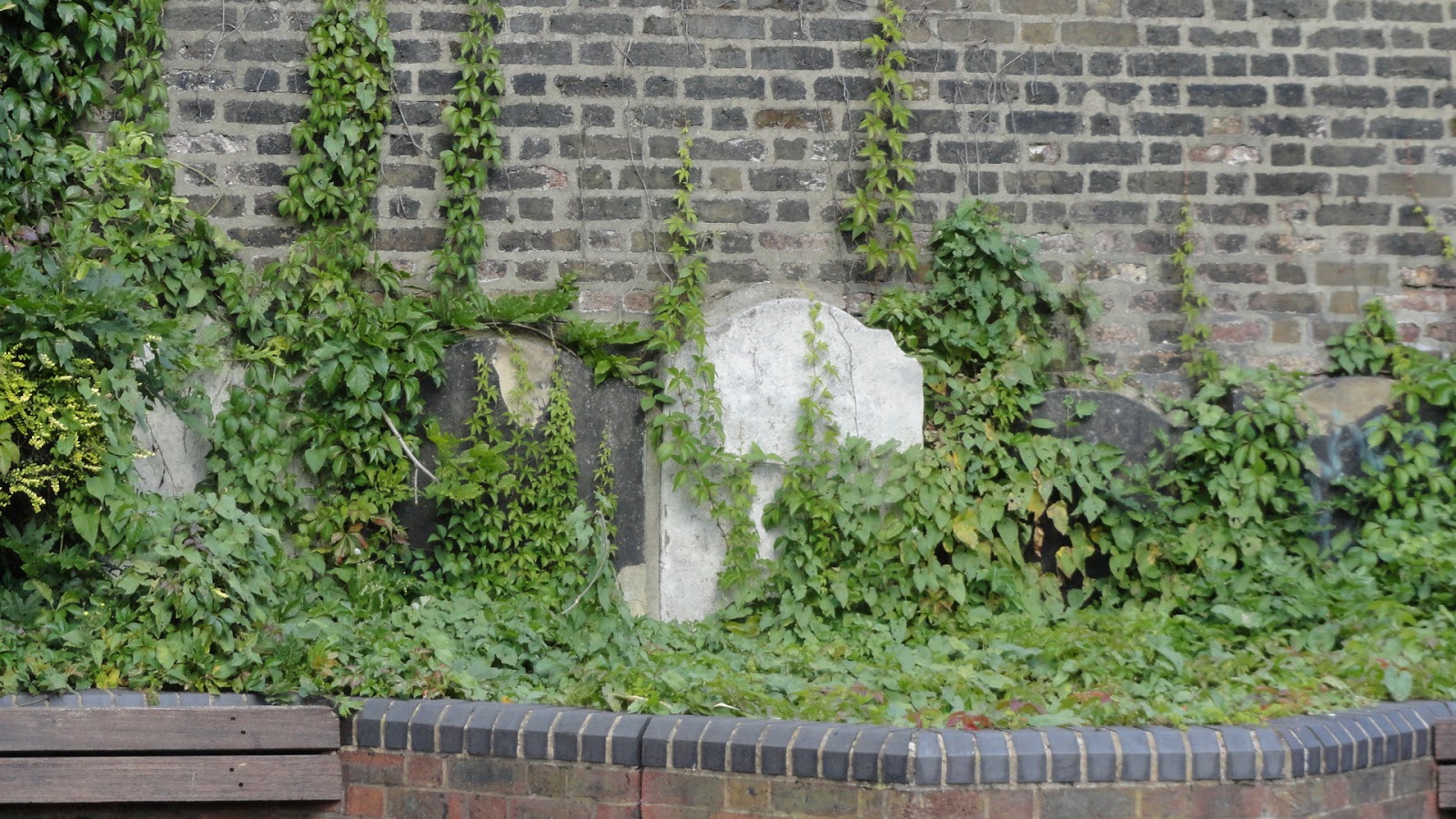
On a recent guided walk around Vauxhall one of the stops was a park which used to be a burial ground. It's shown near the top of this 1817 map as 'New Burial Ground', by which time it wasn't so new, having been opened for that purpose in 1703.

Detail from Darton's New Plan of the Cities of London and Westminster and Borough of Southwark, c. 1817 (mapco.net)

The burial ground filled up and was closed in 1853. The land was sold and eventually conveyed to the Lambeth Borough Council. In the late 19th century it was landscaped into a recreation ground and the gravestones moved to the boundary walls. Don't ask me what they did with the bodies 'cause I don't know.

Grave markers which were moved to the periphery of the recreation ground

If you've read my blog for any length of time you'll be aware of my interest in historic cemeteries. The day I volunteered to do garden clean up at Highgate Cemetery, the tour I took of Kensal Green Cemetery, the stunning view of London from atop the hill at Greenwich Cemetery and the fact that I just enjoy poking around ancient headstones and wondering about the people beneath them is sufficient to justify my status as 'geek'. Not only that, but when you're looking for a truly peaceful and quite spot in a bustling city like London, a cemetery is where you'll find it.

Well, there I was, on a beautifully bright sunny day, sufficiently intrigued as to why this plot of ground in Vauxhall was so radically altered rather than letting everyone lie in peace, snapping a few photos so that I might go back later and study it some more when another member of the walking party admonished me to "have some respect".

Beg pardon?

I was so taken aback that I didn't say anything. Perhaps I should have inquired of him why he thought photographing the stones was disrespectful, when they obviously have not been cared for. Neglect, to me, is the ultimate expression of disrespect so he would have been better aiming his admonition at the borough council. My studies have lead to me to conclude that death was not viewed in the past as we view it now, life being much shorter and beset with disease, pestilence, and war. People were lucky to make it past their 40s, many did not expect to. I've also read of women taking rubbings of their beloved's grave marker as a keepsake; would that man tell them in their hour of grief that they were being disrespectful for doing so?

I didn't say anything but if I had it would be this: I am a garden historian. My job is to study the history of gardens and landscapes designed by humans. Pictures, be they sketches, engravings, maps, drawings, paintings, rubbings, etchings, or photographs are an integral part of that study. Burial grounds, be they large or small, are areas of land designed and created by man to serve a particular purpose, just like a public park or private garden. Some cemeteries have exquisite gardens and several around London can boast Grade I and II buildings and monuments constructed with incredible artistry and craftsmanship - skills in danger of becoming extinct - which makes them all fair game for the intrepid history sleuth out to, er, uncover the story behind a piece of landscape. If taking a photo of grave stones that were moved 100 years ago is disrespectful, what about the beautiful 19th century engravings of historic Highgate Cemetery?

Engraving of Highgate Cemetery c. 1858 (victorianweb.org)

Images like this have been invaluable in the restoration and conservation of the Highgate grounds. Are the photos I took of the family marker for Celia Fiennes in the name of historical research disrespectful? Or the pics of my grandparents' and great-grandparents' markers for geneological research? (I can answer that one: no, they didn't mind. They were probably really happy to see me.)

Detail of the grave marker for Nathaniel Fiennes, his wife, two daughters who died in infancy, and daughter Celia (yes, I took the photo)
Actually, I can't see how taking photos of a grave marker would be disrespectful if the intent is for information gathering and study, and especially for conservation and presevation measures when those photos may be the only existing record of a site or feature. I can't begin to count the number of times I've been to a cemetery or inside a centuries old church where the names of those interred beneath the stones has been worn off either by the thousands of footsteps that have trod over them, by wind and weather or worse, vandalism. Heck, every time I grab a snack at Cafe in the Crypt I find myself apologizing to those who may be lying beneath my chair and hoping that records exist somewhere so that their names aren't forgotten.

Grave stones in the floor of Cafe in the Crypt, St. Martins in the Fields at Trafalgar Square (yes, I took this one, too)
And really, when you stop to think about it, touring a cathedral results in the trampling of many a grave, some of them belonging to great worthies of history. Why, I've trodden on the graves of Jane Austen and Celia Fiennes, both historical figures for whom I have tremendous admiration, and both quite by accident, them being reposed beneath the floor and all. Some might consider this shuffling over the stones disrespectful but you gotta think: the people lying beneath those stones undoubtedly knew they would be walked over or knelt on and in those instances their names would be read and they would be remembered.

Where permitted I've happily snapped photos of the interiors of cathedrals and churches, tombs of long dead aristocracy, medieval effigies, grave stones on the floor and in the long grass, and intricately carved memorials. As for taking photos of them being disrespectful, what if, God forbid, the archives were lost? Restoration of any such space would be difficult, if not impossible, were it not for the aid of images. What if the church burned to the ground or some other natural disaster struck, like municipal development, that forever damaged or destroyed the markers intended to signify a person's final resting place? When I saw the marker for Celia Fiennes it was mounted on the wall but only because the church was rebuilt 100 years after she was buried so it effectually no longer marks her exact final resting place, which was beneath the stones of the church's floor. Besides, she was a progressive woman; I think she would have been intrigued by the curious device I was using.

Well, we know that bodies have been and continue to be moved, sometimes under horrific circumstances sometimes out of necessity, which is a helluva lot more invasive than snapping a photo of the marker from 10 feet away. So, to that person on the walk I say, I will - respectfully - continue to take photos of burial grounds when permitted and thank you very kindly for giving me such an appropriate blog topic for this spectral time of year. To celebrate, I give you a sampling of the frightening and fabulous architecture and artistry that are historic burial grounds, monuments and markers (all photos by me, except where noted, and all taken with the utmost respect).

Getting into Goth sprit at the Kensal Green Cemetery tour


Hooray for grassland conservation at Greenwich Cemetery


Greenwich Cemetery


The most beautiful military graveyard I've ever seen at Greenwich Cemetery


Early 19th century grave stone artistry at Cafe in the Crypt, London


At Kensal Green Cemetery


Kensal Green


18th century marker at Salisbury Cathedral


Monument at Highgate Cemetery


Medieval effigy at Salisbury Cathedral


The Gothic architecture of Salisbury Cathedral


Johannes Wordsworth at Salisbury Cathedral


Monument detail at Salisbury Cathedral


Hauntingly beautiful military marker at Salisbury Cathedral


Highgate Cemetery, London


Highgate Cemetery, London


Markers in the garden at Postman's Park, London


One of the touching plaques at the G.F. Watts's Memorial to Heroic Service at Postman's Park, London


Beautiful and ghostly image from Melbourne Cemetery, Melbourne, Australia (I didn't take this one but I know who did and it was fellow history enthusiast Claudia Funder).


Tomb marker for a member of the Austen family (relatives of Jane), St. Mildred's Church, Tenterden, Kent


Jane's marker at Winchester Cathedral (austenonly.com)


Detail of the memorial to Sam Wilson (d. 1918) by E. Caldwell Spruce, Lawnswood Cemetery, England (appythegardener.blogspot.com. See, I'm not the only one).

Happy Halloween!