For weeks - no, months - now the staff here has been hard at work preparing the Christmas decorations and horticultural displays that will make up Longwood's Christmas season in the gardens and conservatories. The Arborists have been stringing lights since August, Poinsettias were potted up in June, ornaments and greenery have been painted and pinned to wreaths. Starting tomorrow at 5pm the transformation begins. Here's a sneak peek at some of the elements of Longwood's Christmas displays:
October in the garages of the Pierce-DuPont House
Silver Salal
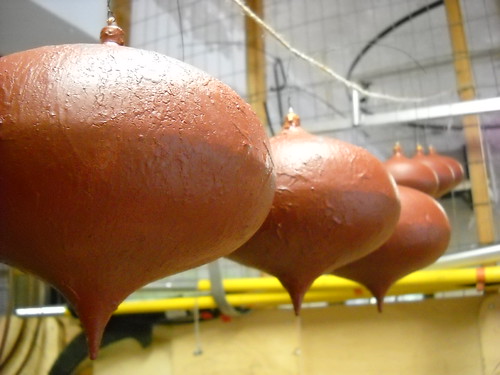
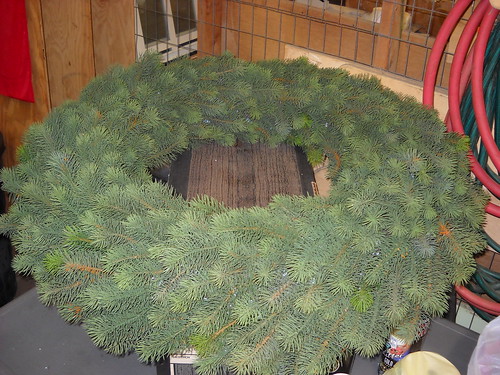
Primed ornaments (they've changed color about three times since this was taken!) One of the treehouse wreaths awaiting ornaments and bows (I did the greens!) Silver and gold wreath in progress in the Potting Shed
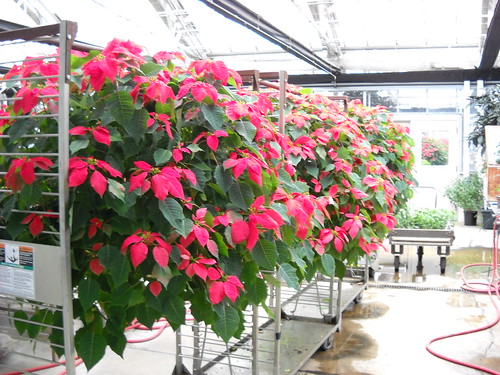
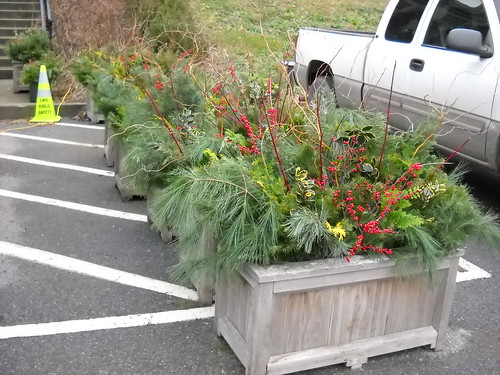
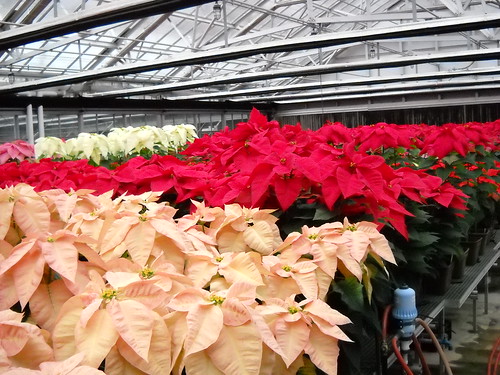
Poinsettia baskets in the Production Greenhouse, ready to go Window boxes that will line the entrance to the Conservatory
The Production Greenhouses are looking quite festive!
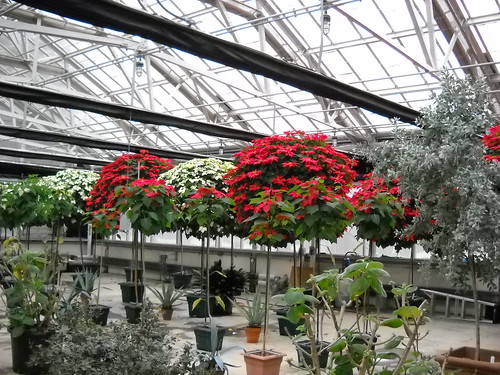
Poinsettia standards that the production staff have been training for two years! (next year's standards are the small ones in the foreground)
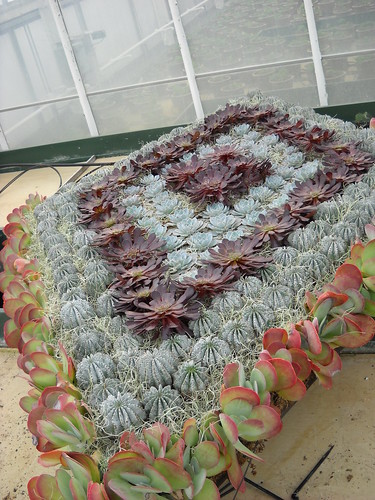
A Succulent Medallion that will adorn the wall of the Silver Garden
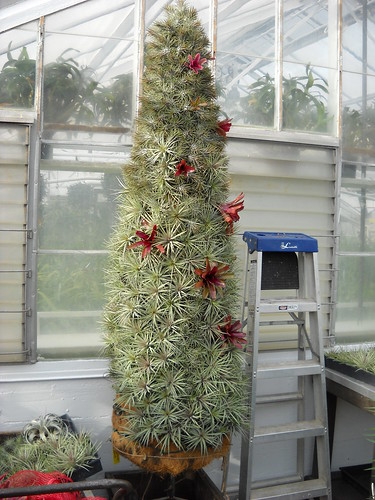
Tillandsia tree for the Tropical Terrace
Poinsettias and Begonias in the Estate Houses
Check back next week to see the Winter Wonderland that is Longwood Gardens at Christmas time!
What? More mums!? It's hard to believe that my first contact with mums back in June would become part of this:
As I near the end of a full year at Longwood, one of my favorite things is to see something in the gardens or the displays - a plant, a design, a project - that I worked on months previously and which is now being realized, displayed, implemented, and cooed over by adoring guests. It makes one feel rather proud. More than anything, I feel awed and humbled when I'm able to say, "I had a part in that". Now, I have no idea which of the 8, 567 mum cuttings I potted up last spring went where, but every time I walk through the conservatory and look at the Thousand Bloom, I smile. Why? Because I had a part in that.
A very small part. Minuscule, to be honest. Microscopic, in the grand scheme of mum training, really. But a part nonetheless.
I bet you're wondering to yourself, "What is a Thousand Bloom, anyway?" Well today is your lucky day! Let me introduce you to the Thousand Bloom:
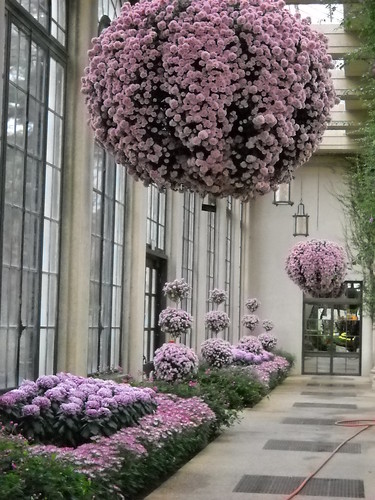
What you see here is a feat of botanical art and engineering. This is one plant - one plant! - that has been meticulously trained to produce over 700 perfectly spaced blooms. 718, to be exact, which makes this the largest Thousand Bloom Chrysanthemum in the US. So there.
This amazing art form began in China and Japan some 200 years ago (Thousand blooms, bonsai...those folks were really into controlling nature in a big - or small - way!). Apparently there are only a handful of growers who know how to do this sort of thing these days and one of them is right here at Longwood. She travels to Japan during each growing stage of the entire process to learn from the masters there, then brings that knowledge back and applies it to this rare and wonderful art form. Can you believe that the plant which will be trained into next year's Thousanda Bloom is already being grown in the production greenhouse!?
Moving the Thousand Bloom into the Conservatory was a major undertaking and I wish I could have witnessed it first hand. I did manage to snap a few shots of it soon after it was moved, as it was being coiffed in preparation for its debut to the public.
Longwood even produced this cool video to showcase this special horticultural achievement:
Along with the Thousand Bloom (or 718 Bloom) there are two smaller Bloomers with about 200-something blossoms on each. One of them sports three different colors of flowers and, yes, it's just one plant! The different colors are achieved by grafting different varieties onto the parent plant. Cool, huh!? And guess what? I got to spend a day disbudding them!
Each and every stem trained on these plants produces multiple flower buds. In order to get the uniformity desired, all but the largest bud are painstakingly removed. It's an arduous exercise in extreme tediousness, but when you're in a zen-type mood it's not so bad and can be rather meditative. I'm proud to say I worked on both the smaller Thousand Blooms and only snapped off two buds! Whew!
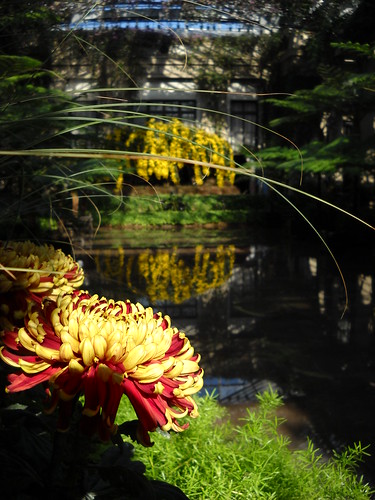
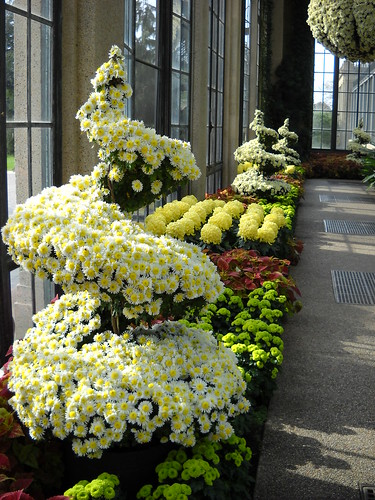
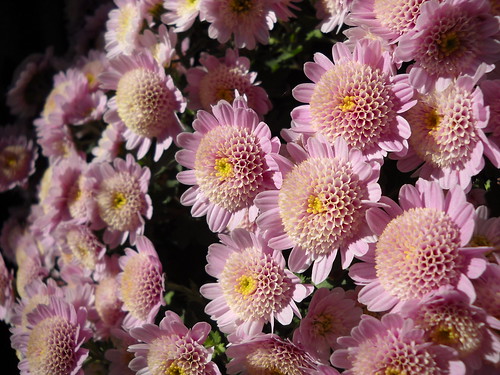
These are the stars of the Chrysanthemum Festival here at Longwood. Other mum art includes the hanging baskets, collars, topiaries, and specimen plants that are currently to be found in every corner of the Conservatory. I don't think there's a student at Longwood who hasn't worked on the mums at one point or other. When I was in Greenhouse Production in June and spent most of the month potting mum cuttings, one of my classmates was over on the other side of the nursery bending and tying stems on the many curtain forms, training the plants that would one day become the floriferous collars worn by the pillars in the conservatory (watering them is an art form in and of itself). I wish I could show all of this to you in person but you'd have to get here quickly because the Chrysanthemum Festival ends next weekend! In a matter of days, all that you see in these photos will be replaced with Poinsettias and other festive Christmas bloomery! For now, enjoy the photos and make plans to visit Longwood next year.
If you time your visit during the Christmas display, I'll be able to show you the Poinsettia standard that I grafted a wee bud onto all those months ago. It's in the production greenhouse as we speak, aspiring to become a 10' tall 6' wide Poinsettia masterpiece...and I had a part in that!
Answer: A lot! Not to mention the full time staff!
All those labels can only mean one thing...
BULBS!
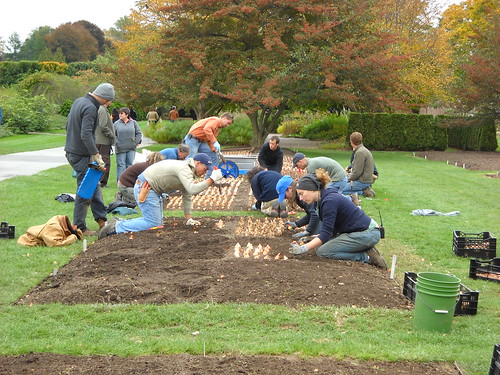
It all starts in the Idea Garden. First the annual beds are demoed, much to the shock and horror of our guests ("WHY on earth are you RIPPING OUT all those BEAUTIFUL PLANTS!?"). If I had a dollar for every time I heard that. Or for, "Why are you putting all those onions out there?" You doubt me, don't you!
After ripping out all those beautiful plants and consoling sufficient numbers of disturbed guests the beds are tilled, raked, leveled, and raked again.
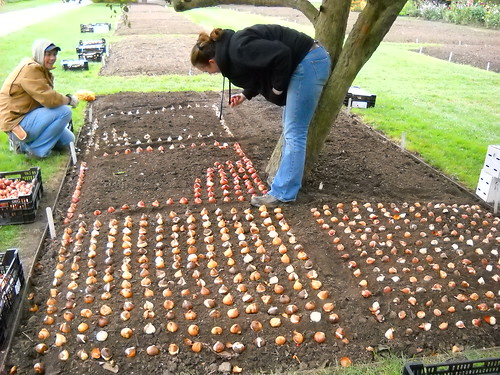
The bulbs in the Idea Garden are set out in a grid pattern. To establish the pattern, two people fumble around with the dibbler and get it just so, then we "walk the dibble" to mark the squares.
Greg's been framed! Or should I say dibbled!?
Once each square is marked, bulbs are set around the perimeter of the squares. From there the squares are filled in with the type of bulb specified on the plan.
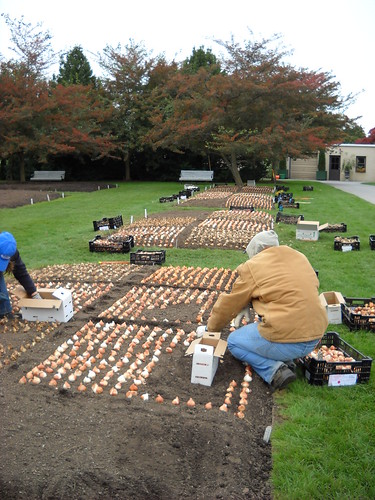
Then we get to work setting out all 75,000 bulbs. Yes, I said 75,000.
This is our supervisor Smokey. He personally inspects all the baskets of bulbs.
"Now let's see, was that 56,872 or 56,873?"
And it seems to go on and on and on...
Many hands make, uh, oh you get the picture...
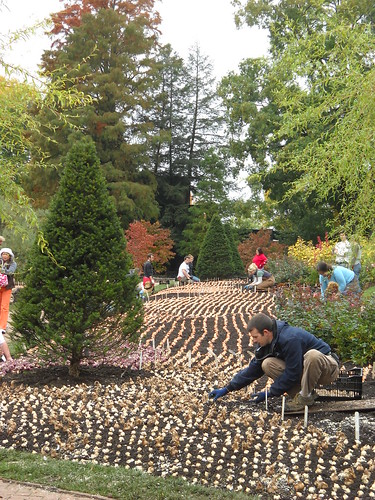
After a week or so in the Idea Garden, the fun moves over to the Brick Walk...
The patterns here are much more intricate.
And there are a lot more bulbs. A LOT more!
Like, about 100,000 more! Yes, I said 100,000 more!
And we can't forget the Square Fountain garden.
After the bulbs are placed and planted, the beds are smoothed over and protected from hungry critters with netting.
Just when we think it's all over, the beds in front of the Visitors' Center beckon!
And then, finally, all the bulbs are tucked into their beds for a nice winter slumber. Come spring, they will wake up and...well, you'll just have to come back and see!
A Horticulturist and Garden Historian. I've gardened at two world famous gardens and earned my MA in Garden History in London. I love gardens and I love their stories. You'll get plenty of both here. Just so you know, all thoughts, opinions, suppositions, and ruminations featured here are my own.


 One of the treehouse wreaths awaiting ornaments and bows (I did the greens!)
  Silver and gold wreath in progress in the Potting Shed
 One of the treehouse wreaths awaiting ornaments and bows (I did the greens!)
  Silver and gold wreath in progress in the Potting Shed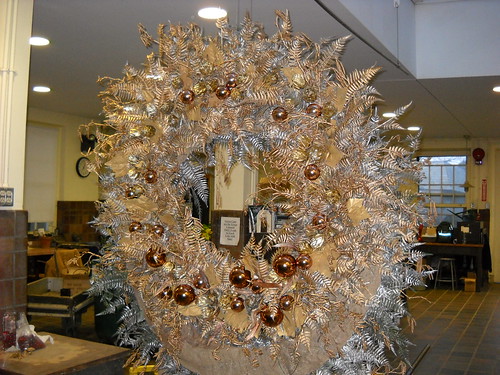



 Poinsettias and Begonias in the Estate Houses
 Poinsettias and Begonias in the Estate Houses

 As I near the end of a full year at Longwood, one of my favorite things is to see something in the gardens or the displays - a plant, a design, a project - that I worked on months previously and which is now being realized, displayed, implemented, and cooed over by adoring guests. It makes one feel rather proud. More than anything, I feel awed and humbled when I'm able to say, "I had a part in that". Now, I have no idea which of the 8, 567 mum cuttings I potted up last spring went where, but every time I walk through the conservatory and look at the Thousand Bloom, I smile. Why? Because I had a part in that.
 What you see here is a feat of botanical art and engineering. This is one plant - one plant! - that has been meticulously trained to produce over 700 perfectly spaced blooms. 718, to be exact, which makes this the largest Thousand Bloom Chrysanthemum in the US. So there.