Pages

31 July 2018

Threat of Giant Hogweed Invasion Found to be Giant Hogwash

First, a story:

When I was gardening at Great Dixter some years ago, I met one of the bad boys of the plant world: Giant Hogweed. I remember the encounter quite well, particularly because of Fergus's stern admonition as to what might happen if we didn't heed his warnings about how to approach it. While Giant Hogweed looks pretty and impressive, this plant's sap can cause severe burns on exposed skin and if it gets in your eyes, well, it's bad. Really bad. Like, go to the hospital and probably should learn Braille, bad.

So there we were, the four of us, charged with the task of ridding the garden of a particularly large specimen. The reason I remember this so clearly is because three of us took precaution to the next level with tall boots and long socks, long trousers, long sleeves, heavy gloves, goggles, hats, and bandannas over our faces. We looked like a crew of botanical outlaws! All but the French intern, who took up the machete with a glint in her eye and started slashing the thug to bits, wearing only trainers with short socks, running shorts, and a tank top. Amazingly, she suffered no harm and together we vanquished the enemy, reducing its 12' height and about 8' width into several sturdy garbage bags. 

So when the sensational news recently came out about the state of Virginia being invaded by a whole colony of Audrey-like marauding Giant Hogweed, I noticed because I live here now. Since I had lived to tell the tale of my English encounter with the weed, I really didn't see what the big deal was but the news made it all the way across the country and I started receiving concerned emails from friends in California. Surely an authority in the plant world would come forth and set the record straight but it took several days of hearing about it on the radio and seeing it plastered all over the internet and social media before anyone did.

My favorite headline was from the New York Times, cheekily borrowing that soothing phrase from The Hitchhiker's Guide to the Galaxy, 'Don't Panic!' after warning of burns and blindness.

So what is this pestilential plant and should you be worried about it? The short answer is no, but let's start with properly identifying it and how to deal with it, if found.


A poster warning of the harmful effects of exposure to Giant Hogweed sap.
New York State Department of Environmental Conservation


Plant names often contain hints as to a plant's physical characteristics and Giant Hogweed is just that - giant. It can reach 15' in height and the leaves can be upwards of 5' wide with stems up to 4" in diameter. To say it has presence is an understatement and so isn't something you're likely to accidentally brush against on a hike. You'd really have to blunder into it in a big way. The airy white flowers form an umbel (same root word as 'umbrella') which reveal its relation to the carrot family (which also includes the common culinary herbs parsley, fennel, anise, celery, coriander, cumin, and dill) but please don't try to eat it! 

Since it seems so easy to identify, why all the sensationalism? There are several other plants in the same family here on the east coast that may be mistaken for the Giant Hogweed and since some can cause adverse reactions through touch or ingestion, it's important to know the difference. Here in NoVA a more diminutive cousin, Queen Anne's Lace (Daucus carota), is a common and prolific wildflower; however, another cousin, Poison Hemlock (Conium maculatum), also grows in this region. I made it my personal mission to be able to identify them when a former employee kept insisting that the Queen Anne's Lace in the garden was in fact Poison Hemlock and nothing I said or showed him could convince him otherwise. My conclusion: he was not a person I wanted to be stuck in a forest with having to forage for food because he would surely kill us.

But I digress.

Instead of plodding through all the plants to avoid, it seems easier to me to identify the one that's safe, or least likely to eat you alive. Anything else that looks similar but doesn't display the same characteristics probably should be avoided. At best, one should use common sense and proper PPE (personal protective equipment) when dealing with this family if you don't know precisely who you're dealing with.

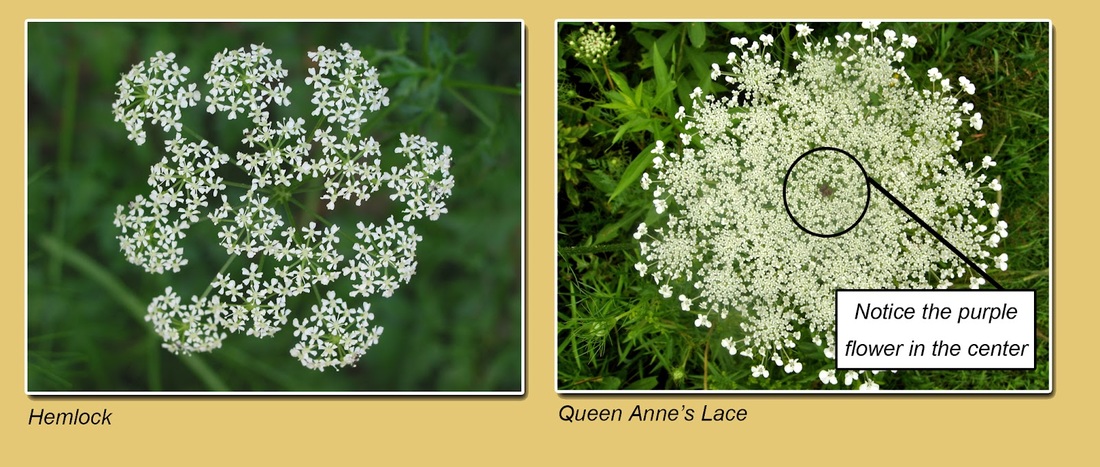
Daucus carota, commonly known as Queen Anne's Lace or wild carrot, is an herbaceous biennial that grows about 3' tall. The stems are green, rough, hairy, and solid when cut. The small white flowers form a dense umbel (there's that word again) with a purple flower in the center.

An umbel of Queen Anne's Lace in full flower. Notice the purple flower in the center. Notice also that I'm touching the stem with no glove on. Some people may experience an irritating reaction from the hairy stem, and those who are photosensitive may get blisters from exposure to the sap.

A Queen Anne's Lace umbel in profile. The stems are hairy and completely green, with no blotches of color.
  
The solid core of a cut stem of Queen Anne's Lace.

Meet 'Dara', a colorful ornamental variety of Daucus carota. She still sports a darker purple center.

To me, the most immediate way of telling the wild carrot apart from Poison Hemlock is to cut it. If the stem is hollow, step away. After all, this is the plant that killed Socrates. Unlike the Queen, Poison Hemlock grows taller, has smooth stems with purple blotches, the umbel isn't as dense and the purple center is conspicuously absent.
Picture
http://bcpoultryhobbyfarmingnetwork.weebly.com/know-your-plants.html

For those in the know, neither Queen Anne's Lace or Poison Hemlock can be confused with Giant Hogweed, seeing as it's so much bigger than either of them. That's why it's handy, not to say important, to Know. Your. Plants. As Marie Curie once said, "Nothing in life is to be feared, it is only to be understood. Now is the time to understand more, so that we may fear less". Knowing what Giant Hogweed is in the first place, and understanding how to deal with it in the second, means you shouldn't have anything to fear. I don't for those reasons, and because I had a good teacher who didn't just send a bunch of novices to deal with a dangerous plant without properly arming us first. 

So what should you do if you think you spot one? First of all, Don't Panic! And don't touch* it if you're not sure what it is. Take a few photos of the leaf, stem, and flowers and send them to your local Cooperative Extension agent. This guide from VA Tech has a table showing the differences between several similar plants that are often confused and this handy media advisory, which also says to not panic and indicates that the population isn't spreading and there's really nothing much to worry about after all, provides more information on how to report it if you think you've spotted it. 

So, forewarned is forearmed and understanding eliminates fear. If that doesn't convince you and all the Giant Hogweed hullabaloo still gives you nightmares, just remember:


*Giant Hogweed sap is phototoxic and causes severe skin inflammation when contacted skin is exposed to UV rays. If contact is suspected, get out of the sun and thoroughly wash affected area with soap and water. If irritation persists, consult a physician. If it gets in your eyes, rinse immediately with clean water and seek medical attention.

01 May 2017

May

"The very word May, short and direct, seems full of light and ready to become airborne. Man compares himself with the world around him, with the birds shouting their songs, the trees bursting into leaf; old or young, in imagination or in fact, he feels himself a part of this great creative impulse."

Christopher Lloyd in Christopher Lloyd's Gardening Year

19 February 2017

Shakespeare in the Garden

I've been trying to come up with new ways to keep my crew at work motivated and to convey the daily task list in a less monotonous form (because, let's face it, gardening isn't all glamorous work, sometimes we have to get our hands dirty).

This week I'm going to try a Shakespearean approach and see how it goes:

GARDENER [to the first man]
       Go, bind thou up young dangling apricots
Which, like unruly children, make their sire
Stoop with oppression of their prodigal weight.
Give some supportance to the bending twigs.
[to second man] Go thou, and, like an executioner, 
Cut off the heads of too fast-growing sprays
That look too lofty in our commonwealth.
All must be even in our government.
You thus employed, I will go root away
The noisome weeds which without profit suck
The soil's fertility from wholesome flowers.

[The Tragedy of King Richard the Second, Act III, Scene IV]

www.shakespearesengland.co.uk
 

16 February 2017

Oh, Deer

One of my favorite TV shows growing up was Mutual of Omaha's Wild Kingdom. Each week I'd watch the ivory mustachioed host, Marlin Perkins, traverse the globe presenting exciting tales of wildlife conservation. It was probably my first exposure to conservation issues and corporate sponsorship. For a kid growing up in Suburbia it was all about exotic locations and wild beasts that I would probably never have the chance to see up close and personal.
 
Then I became a gardener and moved to the east coast.
 

Every region of the world has their native pests that are the bane of a gardener's existence: in So Cal it's gophers and grubs; in England it's badgers and tourists; here in the Mid-Atlantic it's white-tailed deer.

A mature buck lounges in the Pachysandra, digesting his lunch

When I arrived as Director of Horticulture at my former employer several years ago, I was surprised to find a small herd of Odocoileus virginianus in residence. The fence surrounding the property had been breached several times due to storms and vandalism. A few attempts to drive the deer out proved unsuccessful and the deer were happily noshing the garden away.

One way to tell you have a deer problem in a wooded area is if you can see through the forest. The absence of an understory and ground cover layer are indicative of over browsing. Deer are native plant connoisseurs and will munch all the desirable plants that other birds and insects rely on for food and shelter, creating an imbalance in the local ecosystem. One day I popped out of the laundry room at home and came face to face with a herd in the parking lot. These deer were munching their way along the stream out back but I noticed they neatly avoided the boulder covered with budding poison ivy (apparently they know the poison ivy mantra, too).


According to experts, the numbers of white-tailed deer currently roaming the streets is way more than it was when Colonists first settled the eastern sea board 300 years ago. Native Americans and arriving settlers would hunt deer for their meat and hides. Natural predators also kept the populations in check, maintaining balance in the ecosystem. Then the human population boomed, cities were built, habitat was destroyed. The number of deer plunged and laws were passed to save them resulting in an exponential increase in the population. With no habitat left, they began to infiltrate the suburbs and remaining forest edges created by urban sprawl.

A buck and a doe out for lunch in the parking lot at my apartment
 
An adult deer will eat 6-8 lbs of vegetation a day. Multiply that by the eight deer that were stuck inside the fence and you'll see that the garden where I worked was on the fast track to not being a garden at all. The historic rose garden had already lost a season of bloom and the yews were nibbled to stubby twigs. Don't even get me started on the seas of New Hostas that Never Grew. I knew that controlled hunts were commonly used in larger public gardens to manage the deer so I wasted no time in organizing one.
 
The hunt would have to be bow because of the dense residential area, and it would have to be carefully managed. When I breached the subject I was met with much resistance: "The city would never allow it", the nay-sayers said. "Have they ever asked?" I asked. Well, er, no, they hadn't. So I asked, the city said yes, and a resolution was passed to allow a bow hunt in the garden.
 
As fate would have it, I connected with the Oak Ridge Sportsmen's Association, who happily satisfied the insurance requirements. They were skilled, they were experienced, they were knowledgeable, they were shocked that I got the resolution passed. So they came, they strategized, they hunted, and they got all the deer. They were awesome!
 
One of my requirements was that at least 75% of the deer harvested go to a food bank and I'm proud to say the hunt resulted in 320 meals being donated. Once the snow melted, you could almost hear the garden breathe a sigh of relief in the knowledge that it could get down to the business of growing again without fear of being eaten to death. As it is, the damage already done was extensive and will take years - no, decades - of wise stewardship and planning to restore. In this age of instant gratification and high speed everything, people lose sight of the fact that while it can take a herd of hungry deer (or a hurricane, or earthquake, or whatever) a very short time to decimate 6 acres of woodland, it will take much longer for it to recover. Unfortunately those people often aren't gardeners nor do they spend much time in nature. If they did they would understand that nothing in nature happens over night.
 
Invasive species that take advantage of the gaps created by an absence of native ones have to be eradicated and the areas replanted or the natives allowed to regenerate. New plants have to be monitored and cared for to ensure survival, and the invasives constantly beaten back until the balance is restored and nature can take care of itself again. Restoration takes a lot of work and a lot of time.
 
Pachysandra, a native of Asia, is a shade loving ground cover that spreads rapidly in the humus rich soil of a forest floor. Though also native to parts of SE US, it's been declared invasive by several eastern states.
 
Every conceivable non-lethal method had been attempted to remove the deer from the garden in the past and failed, leaving a managed hunt as the best possible option. If I hadn't pushed it through, the herd would have more than doubled in the spring (let's see, 15 deer eating 8lbs of garden each day is...times 5, carry the 1...yikes!). It's a touchy subject for many but getting rid of the deer was the only way to save the garden and save it we did (tip of the hunter orange cap to you ORSA guys!). It would have been interesting to see how the woodlands there regenerate and perhaps someone will take advantage of the opportunity now presenting itself and I'll read about it in ten years or so. 
 
A similar, though much larger, study was done at Yellowstone National Park which was also overrun with deer. They took more drastic measures and reintroduced a pack of wolves to do the hunting. The result was a trophic cascade - an ecological phenomenon triggered by the addition or removal of top predators and involving reciprocal changes in the relative populations of predator and prey. And while the Mutual of Omaha loving kid in me thought having Marlin Perkins cover the interaction of wolves and deer in a suburban garden, they unfortunately weren't an option.


02 December 2015

Osculate Me Under the Obligate Hemiparasite

Welcome to December and all the seasonal festivities and frivolities married to it! Few holidays have such a diverse number of traditions and customs. I mean, who came up these and why are they related to Christmas: eggnog, fruitcake, decorated conifers, socks on mantles, and swapping spit under mistletoe, just to name a few (and those are only the decidedly American holiday traditions. You should hear what they do in other countries!).

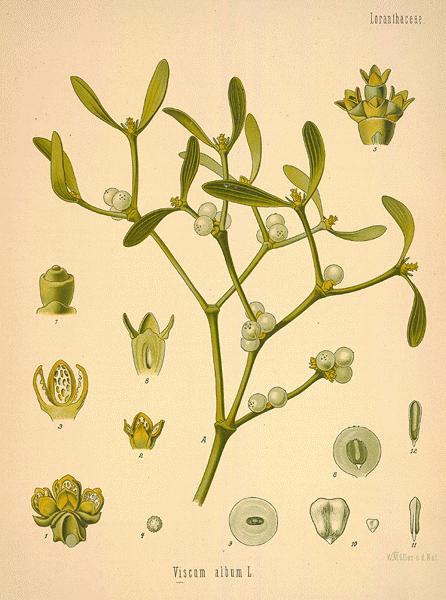
Actually, we did borrow the mistletoe thing from Britain, like most things which are so awesome and British. And the British being born gardeners, well, they know a thing or two about plants. What other culture would write a Christmas carol about holly and ivy? As the great global melting pot, not only do we often borrow foreign customs, we frequently take their plants, too. Viscum album, the native species found in Great Britain and much of Europe, having now been introduced to North America, is an evergreen plant with a woody stem which grows on and gets most of its nutrients from a host. It does photosynthesize a bit, but not much, which is what makes it a hemiparasite, and that's a compliment, really. The Latin name is likely derived from the sticky seed coating (viscum) and the color of the berries (from 'albus', meaning white).

The species native to Spain, Portugal, North Africa, Australia, and Asia is Viscum cruciatum (sounds like a Harry Potter spell, doesn't it?).

Potter Wiki (no nargles here)
All in all, there are over 80 genera with more than 900 species of Mistletoe. And the family name that these plants belong to? Wait for it....Santalaceae.

I kid you not, but it has nothing to do with Santa Claus. (Or does it? Nah.) Mistletoe is related to Sandalwood. It also happens to bloom and set fruit right around Christmas time when most other plants in the Northern Hemisphere are settling in for a long winter's nap. Once dissected, the common name is anything but complimentary. The name mistletoe comes from the Anglo Saxon word 'mistel' (which means dung, probably a reference to how the plant is propagated) and the Old English word 'tan' (which means twig). Roughly translated, mistletoe means 'poo on a stick'. Isn't that...special!


botanical.com


Mistletoe has been known and used in Herbalism for centuries and parts of the plant were prized by many ancient cultures for their healing properties. The Greeks used it to cure everything from menstrual cramps to spleen disorders, while over in Rome, the naturalist Pliny the Elder noted its use as a balm against epilepsy, ulcers and poisons (ironic, since the berries are poisonous to humans).

The plant’s romantic associations most likely began with the Celtic Druids of the 1st century A.D. Since mistletoe can blossom even during the frozen months of winter, the Druids came to view it as a sacred symbol of vim and vigor, and it was administered to humans and animals alike in the hope of restoring fertility (again, poison! Raising eyebrows, here). The association with fertility and vitality persisted throughout the Middle Ages. Some considered it an aphrodisiac (Poison! Does no one listen!?) owing to the allegedly sexual nature of the plant: the Y-shaped branches, white sticky juice from pearl hued ball-shaped berries hinted of...let's not venture further...ok, lets. Ironically, it's the female plant that bears the poisonous fruit while the male plant is conspicuously berry-less. Let your Freudian brain puzzle that one out over a mug of 'nog for a while.

By the 18th century mistletoe had become incorporated into Christmas celebrations around the world. The 'downstairs' class of Victorian England is credited with first recording the tradition of kissing underneath the mistletoe. Taking their cue from the Druids' and their fertility rituals, the tradition of kissing beneath the mistletoe dictated that a man was allowed to kiss any woman standing underneath the boughs, and should any woman refuse the overture, ill luck would befall her. Another variation on the tradition stated that with each kiss a berry was to be plucked from the mistletoe, and when all the berries were gone, the smooching must cease. Many a serving maid scurried into hiding when the mistletoe was hung, as described by nineteenth century writer Washington Irving: "the mistletoe, with its white berries, hung up, to the imminent peril of all the pretty housemaids."


"Ah, what an excellent specimen of Viscum album! Did you know this lovely plant is actually a parasite!? Why, it's extraordinary, really! You see, it actually grows in the branches of trees, not in the ground! Yes, isn't it remarkable? The seeds are eaten by birds, whereupon they pass through the digestive tract, or gut, and are shat out onto a tree branch where the seed sprouts by sending out rooting tendrils called haustorium..."

"Will he ever shut up and just kiss me?"

Kissing under the mistletoe caught on, surprisingly, and continues as a holiday sport to this day. I suppose of all the wacky Christmas customs, smooching under a parasitic plant is more pleasant, and infinitely more preferable, to a regifted 10-year old fruit cake.


www.chron.com
 

So while you're enjoying the eggnog and petrified fruitcake at your next holiday gathering, keep an eye out for halls decked out with that most romantic of evergreens, pucker up, and whisper seductively to your sweetheart, "Osculate me under the obligate hemiparasite". That'll get hearts racing, I guarantee it!

06 June 2015

Double Trouble

"So we grew together, like to a double cherry, seeming parted, but yet an Union in partition. Two lovely berries moulded on one stem; So, with two seeming bodies, but one heart"

~ William Shakespeare, A Midsummer Night's Dream


09 March 2015

Spring Is Come

Behold, my friends, the spring is come; the earth has gladly received the embraces of the sun, and we shall soon see the results of their love.

- Sitting Bull


09 October 2014

October

"Very much a favorite month, this. Even writing a capital O at the start of its name is a pleasure. Of course, the weather can be foul; when can't it? But October does give us spells of the most delectable weather, too, and the golden warmth of its light invests everything with its glow. Nights have a nip in them but by day the air is soft again and we just need to relax in appreciation."

- Christopher Lloyd in Christopher Lloyd's Gardening Year


07 September 2014

Are You My Mum?

Autumn is coming, whether (or should that be 'weather'?) we're ready or not! A heat wave last week sent fall annuals into overdrive so mums are fully blown, but the mild summer also means summer annuals and perennials are still growing strong. Ack!

Still, one must prepare for the inevitable so I did what any sensible gardener would do: I paid a visit to Longwood Gardens PG Class of 2015's greenhouse.

Second year students in the PG program enjoy an educational trip abroad focused on horticulture and public gardens, and are responsible for raising half the funds for the trip. Part of their fund raising effort includes growing and selling plants at three major sales during the year. 

This week is their Fall plant sale but I was allowed to pre-shop (one of the perks of being an alumna!). Guess what I'll be doing at work this week?


Thanks to Nick and Lincoln, PG Class of '15, for helping me load the truck!

28 July 2014

Thence I Went...Under Ground

On her 1697 tour of northern England Celia Fiennes visited landmarks rightly considered to be (and cannily marketed as) "great wonders". One such were the underground caverns called Poole's Hole, now known as  Poole's Cavern. It was a tourist attraction as early as 1622 and widely written about over the next few centuries (but I noticed Celia's account is scandalously omitted from the website's Literary Heritage page - for shame!).

No wonder that I thought of her when I visited the Luray Caverns, 'a subterranean world of wonder' right here in northern Virginia.

Limestone and mineral rock formations in Luray Caverns

Celia described her visit to Poole and the sights within the cavern:

"Just at the Entrance you must Creep, but presently you stand upright, its Roofe being very Lofty all arched in the Rocks and sound with a great Ecchoe. The Rocks are Continually dropping water all about, you pass over Loose stones and Craggy Rocks. The dripping of the water wears impression on the Stones that forms them into Severall Shapes"

The Luray Caverns were discovered in 1878 but are estimated to be 5 million years older than Celia's caves at Poole. Thanks to a good bit of engineering over the last century modern visitors don't have to 'Creep', you descend into the caverns via a sturdy staircase with signs urging, "Please Use the Hand Rails!" and penetrate into the depths along a bricked path lit with electric lights. I kept wondering what it was like for Celia, having to crawl into the cave (so unladylike, and in a fitted bodice and stays - so uncomfortable!) with no illumination on the path but the light of some candles in a lantern carried by a guide.

Pillars reaching more than 20 feet high
Like Poole's Hole, the cave rooms and some of the formations at Luray have names - all exceedingly fitting: Saracens Tent, Giant's Hall, Dream Lake, Pluto's Ghost, and Titania's Veil. There's even one monolithic formation affectionately called The Shaggy Dog. It's only 7 million years old; a mere blip in the grand scheme of geological formation.

The Shaggy Dog, largest formation in the caverns at approximately 7 million years in the making. At over 40 feet in height, standing before it makes you feel very small, in more ways than one.
Celia's friend and contemporary Daniel Defoe published his three volume A Tour Thro' The Whole Island of Great Britain, Divided into Circuits or Journies between 1724 and 1727. I often wonder if his travels weren't inspired by Celia's tales of her own. I enjoy comparing the two accounts, especially their descriptions of how the caves must have been formed, which I share here with you along with my own:

Celia Fiennes, 1697: "but the difficulty appears as to this hole how so large a Cavity should be Left, as in some places the Roofe is as lofty as you can see and all stone; now how it should be fixt so as not to tumble in by the weight of the Earth or stone on the top: as to the waters dropping it is but what is Customary among rocks and stones, there are many springs which run in the veines of the Earth and allwayes are running in such subteraneus vaults in the Earth, which gather together and runns in a little Channell in the bottom of this Cave"

Daniel Defoe, c. 1724: "It is a great cave, or natural vault, ancient doubtless as the mountain itself, and occasioned by the fortuitous position of the rocks at the creation of all things, or perhaps at the great absorption or influx of the surface into the abyss at the great rupture of the earth's crust or shell."

Deb Wiles, 2014: "Water plus Time equals THAT!? Woooooooaaaaaahhhhhhhhh!!!!!! "

Yeah, whoever finds my travel diary 300 years from now might be a wee bit disappointed.


I do have two advantages over Ms. Fiennes and Mr. Defoe, though. Namely 300 years of scientific advancement in geology and a little tool called Google. Like those at Poole, Luray's caverns are "solution caves", meaning a solution of calcium carbonate donates some of its carbon dioxide, allowing a precipitate of lime to form. The limestone which is formed by this precipitate grows at the supersonic rate of approximately one inch every 120 years. Highly acidic water once filled the chambers and ate away the softer material. As the natural water table declined, the chambers drained leaving the eroded forms behind, which are still growing. There are still springs in the caves and a constant drip in places due to surface water percolating down into the caverns. Our guide called these drips "cavern kisses" and claimed each 'kiss' brought 100 years of good luck. I should be set for the next four centuries. I suspect if the dripping at Poole's Hole had such a catchy nick name Celia would have mentioned it but all she says is:

"The dripping of the water wears impression on ye Stones that forms them into Severall Shapes, there is one Looks Like a Lyon wth a Crown on his head, ye water trickling on it weares it into so many shapes; another place Lookes just Like ye shape of a Large organ wth ye severall Keys and pipes one above another as you see in a great Cathedrall;"

I wonder if Leland W. Sprinkle had read Celia's diary when he set about creating the Great Stalacpipe Organ at Luray? It's the largest musical instrument in the world, and took three years to build starting in 1956. Sprinkle reputedly got the idea when touring the caves with his son, who hit his head on a stalactite producing a musical tone. He painstakingly located and shaved thirty-seven naturally formed stalactites to get the right notes, connecting each one to a solenoid and small rubber mallet controlled by a traditional organ console. The caves cover 64 acres and while the selected stalactites are spread around only 3.5 acres within the caves, the sound can be heard anywhere in those 64 acres. It really is an amazing feat of science and musical engineering, and I found myself wishing again for that TARDIS so I could see the look on Celia's face when she heard this:


There is also an underground lake called the Dream Lake. Fed by a spring, the lake is only 20 inches deep but very wide. The water is crystal clear and the still surface creates a perfect mirror reflecting the ceiling above so that it looks as if stalagmites are growing up beneath the water from the lake bed. The photos don't do it justice, and a collective awestruck "Ahhhhh!" came from everyone in the tour group.


Mirrored reflection of the ceiling in the still crystal water of Dream Lake
Different minerals lend their colors to the rocks as well, from brown to red to alabaster white.

The range of colors and intricate layers in this formation can be clearly seen thanks to the lighting


The formations that really awed me were the curtains, or veils. Their delicate waves look like they were carved by a master sculptor (well, I guess one could argue they were) yet each fold took millions of years to form. Mind. Blown.

Part of Saracens Tent, one of the most well formed draperies in the world.


And while Celia noted the formation at Poole that looked like 'a salted flitch of Bacon', Luray's got the fried eggs to go with it:


I still intend to visit Poole's Cavern to see what Celia saw, and I have to admit I'll be a bit disappointed if I don't have to crawl through the entrance as she did, but I love the fact that these wonders exist all over the world and that some can be so similar. Take away the modern amenities and I bet my visit to Luray Caverns wasn't really all that different from Celia's to Poole's Hole. She was a bit of a rebel, though, and broke off pieces of rock as souvenirs. This practice is Frowned Upon and visitors are admonished not to touch the rocks at Luray so I had to content myself with a free piece of Unakite from the museum which my entry ticket entitled me to.

Fitz enjoyed the American version of traveling under ground

Luray Caverns are located in Luray, VA in the Shenandoah Valley. For visiting information go to their website. Guided tours last about an hour. Tip of the day: if you go on a weekend, plan to go early and beat the crowds!

17 July 2014

A Gardener's Garden

Every gardener has a favorite garden. Or two, or twelve. And every gardener I've ever met knows a garden - a gardener's garden - that inspires them, that speaks to their soul, and leaves them with a renewed passion for their profession every time they visit. Whether it's the design, the designer, the plants, the architecture, the artistry, the history, or all the above, there is something about it that resonates. This is mine:

The Gardener’s Garden: Great Dixter on Nowness.com

15 July 2014

What's That Plant?

I simultaneously love and hate when someone asks me the name of a plant that I don't know. I love it because it means as soon as the conversation ends I'll be able to dash to my library to look it up and will learn something new. I hate it because I'm a professional horticulturist with extensive training and education and we're supposed to know these things, right?

Then I remember the story about Christopher Lloyd, one of the - if not The - greatest plantsmen of the 20th century. If he was visiting a garden and encountered a plant that was unfamiliar to him, he'd nudge it with his toe and nonchalantly ask his host, "What are they calling this these days", a cheeky reference to the fact that taxonomists are constantly changing plant names and a brilliant way to mask his extraordinarily rare ignorance. Unfortunately that trick doesn't work when you're the one being asked and you don't know the answer.


So there I was at work - in a garden that's still new to me and that I'm still getting to know - when a guest asked me, "What's that plant?" and pointed to a variegated ground cover with seed heads that clearly mark it a member of the Umbelliferae, which the taxonomists have changed to Apiaceae (see, Mr. Lloyd was really onto something). This puts it in the same family as carrots and Queen Anne's Lace but I recognized it as neither of those. Whatever it was, it was happily colonizing a small space under an apple tree and doing a splendid job of crowding out the Sarcococca*.

After this cursory and incomplete identification, the guest went to her lunch and I went about the rest of my day, temporarily forgetting about the Mystery Plant. Until five o'clock this morning, when I reluctantly awoke from a very pleasant dream with "variegated umbellifer" in my mind and couldn't get it out (we plant geeks obviously have very strange cognitive functions).

You'll be happy to know, then, that the plant in question is a variegated form of Aegopodium podagraria, commonly called Gout Weed** and it's Number 1 on Canada's 10 Most Unwanted List. Introduced to America from Europe and Russian Asia, it was known in those parts as a medicinal and pot (culinary) herb back in the Middle Ages where it was used to treat gout. The 16th century herbalist John Gerard described the thuggish habit I observed thusly:

'Herbe Gerard groweth of itself in gardens without setting or sowing and is so fruitful in its increase that when it hath once taken roote, it will hardly be gotten out againe, spoiling and getting every yeare more ground, to the annoying of better herbe.'

I didn't ask the Sarcococca if it was annoyed, but it sure looks it.


Its botanical name is derived from the Greek words “agios” meaning goat and “podion” which means little foot, combined to "Little Goat Foot" because the shape of the leaf is thought to resemble the shape of a goat’s foot.


Another of its names, Bishop's Weed,*** comes from it's being commonly found near monastic ruins. Monks grew and traded medicinal plants, they being practically the only persons who could travel extensively in the Middle Ages without much fear of being set upon by highwaymen. Saint Gerard lent his name to the plant, as well, being the lucky saint invoked to cure the gout. The roots and leaves have diuretic properties and were boiled or crushed then applied as a poultice, or eaten in a bitter spring salad. It's also thought to be helpful in alleviating symptoms of rheumatism, kidney, bladder, and intestinal disorders, and hemorrhoids (not sure how they discovered that one).

All in all a very useful addition to the early physic garden and the variegation makes this variety a very decorative plant, but it's ruffian personality dictates a ruthless hand in controlling its spread both in the garden and in the wild. It spreads by underground rhizomes and by seed, so cutting off the flower stalks immediately after blooming and pulling it out roots and all are the best control methods. The variegated leaves do make a nice ground cover in an area of dappled shade so long as it's kept in bounds.

Now armed with this bit of information, I'll be ready the next time someone asks me what it is. I might even give it a nudge with my toe and say, "This one? Well, in the Middle Ages it was known by a whole list of names but these days they call it something completely different..."


*Sarcococca hookeriana: also called Sweet Box, makes a nice groundcover. Leaves are deep glossy green in shade with clusters of fragrant white flowers in late winter and early spring.

**Other names include: Ground Ash, Ashweed, Pot Ash, White Ash, Ground Elder, Dog Elder, Dwarf Elder, Garden Plague, Farmer’s Plague, Snow-on-the-Mountain,  Jack Jumpabout, Jump About, Goat’s Foot, Bull Wort, Bishop Wort, Bishop Weed, Herb William and Herb Gerard (whew!)

***Not to be confused with another member of the Apiaceae also called Bishop's Weed for similar reasons, Ammi majus, seen here used to great effect in the garden at Great Dixter.

(greatdixter.co.uk)


13 July 2014

A Review of Queen Elizabeth Olympic Park

I was extraordinarily fortunate to be doing my MA in London during the year which saw the Queen's Diamond Jubilee and the XXX Olympiad. What a year!

In the autumn of 2011 a landscape architect who worked on the design of the Olympic Park gave a presentation to our class; a design teaser of what was then being built. While I was writing my dissertation my tutor, Tom Turner, very generously gave me a ticket to the park so I was able to see it in all its Olympic glory (I can also boast that I ate at the World's Largest McDonald's). In this video Tom and fellow University of Greenwich professor Robert Holden, Landscape Architects both, discuss the post-Olympic landscape of the Queen Elizabeth Olympic Park. I would love to see it again, in light of this review.


07 June 2014

Happy Birthday, Celia!

Were she alive today, Celia Fiennes would be celebrating her 352nd birthday. In the spring and summer 317 years ago she would have been embarking on what she called 'My Northern Journey' in which she traveled from London up to Scarborough and back, traveling about 635 miles on horseback or by coach over 7 weeks.

A page of Celia's diary noting the beginning of her Northern Journey (Wiles, 2012)
1697 is the only travel date she mentions in her diary. And it struck me looking at the photo of the journal entry in her own hand: She made these travels in the year 1697. Sixteen. Ninety. Seven.

No cars, no busses, no trains, sometimes no roads. No electricity, no 4G wireless, no Wi-Fi hot spots, probably no map (she would have hired guides), and none of the modern conveniences that we all take for granted nowadays. I never get tired of reading Celia's diary. In this digital age where selfies are all the rage, I wonder how much of the experience is lost when viewed through a camera lens or on a phone screen as one whizzes through a town or flits from one monument to the next. Hardly anyone keeps a journal any more. Yes, there are blogs (hello!) but one big zap from a power surge like, oh say, Betelgeuse going supernova will wipe out the servers and the blogs will be lost forever. So will the entire solar system, but that's another post for another day.

Burghley House, 'eminent for its Curiosity', built between 1555 and 1587. It had just been remodeled in the modern style by the Fifth Earl when Celia visited in 1697.
Of course I'm guilty of being a rabid picture taker and feel a great surge of gratitude to the inventor of digital photography every time I click the shutter but I'm more grateful to Celia for opening my eyes and mind to another way of seeing the places I visit. I still marvel at the level of detail she includes in her diary and wonder how she managed to retain all that information until she was able to sit down with quill and paper to record it. Seriously, I've seen her diary and she didn't write it in the coach on a bumpy dirt road between destinations.

Celia included a description of her family's seat, Broughton Castle, in Oxfordshire (Wiles, 2012)
Broughton Castle, as it looked 273 years after Celia's death (Wiles, 2012)
Still, these days we tend to rely on the camera to capture views and help us recall details when not too terribly long ago those details would have been recorded by hand, either in prose or drawing. There are no drawings in Celia's diary, though it's reasonable to expect she knew how, 17th century ladies of noble birth being schooled in the arts and all. Either she simply didn't take the time or what sketches she may have done have not survived.

Audley End, built between 1603 and 1616. If Celia's figures are to be believed, at the time of her visit there were 3 courts, 30 towers, a cupola, and 750 rooms. (Wiles, 2005)
Each time I travel I keep a journal of the journey but have not the capacity for memorizing such minute details that Celia did. She challenges me to do better at recording what I see, which helps make the traveling more enjoyable. That's especially true when I visit a place she'd also been to. Several times I've stood before a grand country house, in one of its rooms, or in the gardens with her description in hand and can instantly see how much has changed. Sometimes not much has and a little thrill travels up my spine. Is this the same view she saw? Would she have noticed those trees, that architectural detail, that painting on the wall, did she approach the place on the same road I did? Following in an historic figure's footsteps has to be one of the greatest highs in the life of a historian.


The Chapel at Chatsworth. Celia noted it as being 'very lofty...and supported by 4 large pillars of black marble two at the alter 2 just at the bottom to support the gallery for the Duke and Duchess to sitt in' (Wiles, 2012)

I will be celebrating Celia's birthday in a part of the country that's new to me and I hope I'll be able to take the time to notice things the way she did. Who knows, maybe my travel journals will be found 300 years from now and used to compare what is then to what was now. Better take good notes, then. I might even attempt a sketch or two.

Happy Birthday, Celia!


12 May 2014

On the Case: Garden Detective

As a gardener, there are times when I visit a garden and my hand automatically reaches for my hip and the secateurs that should be there, the itch to restore order to an unruly border a constant garden visiting companion. As a garden historian there are times I step through a garden gate and find myself thrown back in time, too easily seeing the ghosts of gardeners past. It's when these two sensations collide that I know I've found some place special.

I discovered just such a place last week when my friend Dan Maffei, a landscape designer, asked me to take a look at a property he's working on. What was once a farm on the Philadelphia Main Line is now under corporate ownership but the 1930's mansion perched atop a hillside over a once formal garden complete with grotto and reflecting pool, all screaming 'American Country Place Era', are what stopped me in my tracks and made my mouth form a soundless, "Oh."

View of the garden at the rear of the house, complete with grotto.

Overgrown yew hedges and junipers left to smother their neighbors do their best to obscure the garden features but we garden detectives are trained to read beneath the overgrowth (Dan laughed at me as I declared, "I'm going in!" and dove headlong into the thicket). Massive boulders forming a terrace of 'natural' paths with scraggly azaleas struggling to bloom in the shade, the boulders themselves in danger of being consumed by tree roots, and the outlines of a fountain basin still imprinted on the ground tell me this was once a grand garden indeed. Strong axial alignments and a plant palette popular in the 20's and 30's all give tantalizing hints but the identity of the original designer remains a mystery. For now.

This conifer's roots have been growing over the rocks for some time.


The pool terrace

Ever since my tutor used the term I've preferred 'garden detective' to 'garden historian'. It really is surprisingly accurate, after all. In seeking to discover who designed this garden I've got to follow seemingly random leads and apparently minor associations, looking for clues wherever I can. It's a fascinating process, and I was only too thrilled to take the case. I shall be, to the best of my ability, the horticultural Sherlock to my friend's Watson, for while I endeavor to solve the garden mystery it will be Dan who saves it's life.

The goal isn't necessarily a wholesale restoration of the garden, though that depends on what is revealed about its creators and the ultimate desire of the present owner. I think there's more to this garden, though, and while I find myself wishing fervently for a TARDIS (yes, fandoms colliding, I can't help it) I know with a little digging the garden's ghosts will reveal themselves to me in time.

04 May 2014

Happy Star Wars Day!


03 May 2014

Put Your Plants On

Just when you thought there couldn't possibly be any more spring time revelry, I'm here to tell you about World Naked Gardening Day.

Yup, you read that right.

Internationally celebrated on the first Saturday in May, gardeners around the world are encouraged to tend their plots au naturel. I suppose a sun hat would be acceptable, though I think not having a holster on my hip to hold my pruners would be an inconvenience.

Founded in 2005 as a way to interest people in getting back to nature there's a nod, of course, to the First Gardeners - Adam and Eve - who tended their Eden with nothing on, resorting only to fig leaves after they'd eaten of the forbidden fruit.

"Are you sure that's not poison ivy? Oh, look! Shiny!"
Adam and Eve, c. 1701-1704
Antonio Molinari  (1655-1704)

This year a group of professional gardeners in England have taken WNGD a step further by baring all to raise money for Perennial Gardeners' Royal Benevolent Society, a UK charity supporting people in horticulture. Taking their cue from the Calendar Girls, the Twitter formed group called Grubby Gardeners launched a social media campaign by posing in naught but their Wellies in order to reach their goal of raising £20K for Perennial in 2014.

The Grubby Gardeners pose for charity at the Kensington Rooftop Gardens in London
(photo: Jason Window via perennial.org.uk)
Now, I enjoy walking bare foot on the lawn as much as the next gardener but deer ticks and poison ivy are enough to convince me that full coverage is required while I work, so I can't imagine what kind of gardening the proponents of WNGD are thinking of. I do, however, think the Grubby Gardeners' fund raiser is one brave way to get into the spirit of the day and help a worthy cause. So how about it - are you audacious enough to garden in the altogether? Public nudity laws vary, so check the local ordinance before you march out the door in your birthday suit. And don't forget your pruners.

If you're on Twitter, follow the #GrubbyGardeners fundraising efforts @PerennialGRBS.