You might recall the record-breaking snow we had back in February - this is what my garden looked like then:
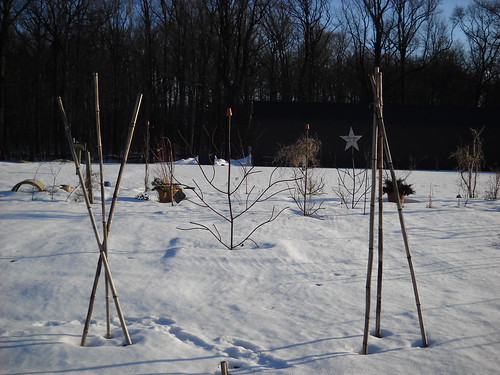
And when the thaw came, here's what was left of the veggie garden:
 And the ornamental garden:
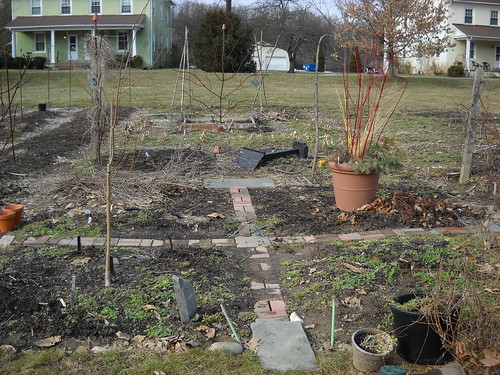 Not a pretty sight, huh? I was amazed at just how many weeds managed to survive 3' of snow and total saturation. Stupid weeds. As I waged war against them, a few rays of hope shot up out of the ground. Take this Leucanthemum x siberian 'Brightside'. Not looking so bright now, is it? But it survived, and looked as if it was going to make a go of things. Considering that two of its companions bit the dust in last summer's flood, I was quite proud of its tenacity and wasn't afraid to tell it so, even though a few people within ear shot gave me funny looks.
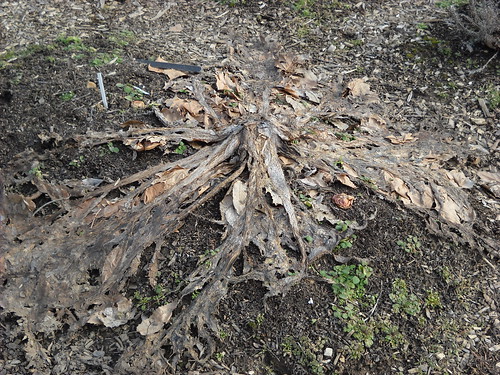
 Sadly, the veg garden didn't fare so well. This is what a couple of blizzards and subsequent snow melt will do to an artichoke plant. Can you say, 'mush'?
 We also had a freak hot spell in April that threw everything all out of whack. Trees and shrubs that shouldn't have come out until May burst indecently into bloom, bulbs weren't sure what to do with themselves, and the perennials in my garden suddenly exploded. A good spring cleaning revealed the stalwarts and re-established order in the beds, some of which received a new crop of herbs and veggies.
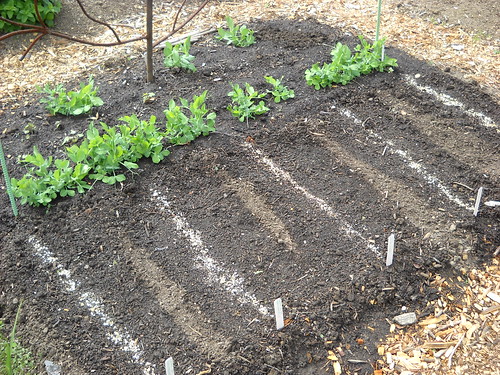
Last year this was the squash bed. This year I planted peas (we're growing several crops to sell to the Terrace Restaurant here at Longwood to help raise funds for our trip abroad which is in - quick check of the calendar - three weeks!!), along with a few rows of carrots and some radishes. A few volunteer seedlings of the fabulous Mina lobata that set the rebar tree aflame are being allowed to stay, so long as they behave themselves (but the bloom is so amazing, I might be willing to look the other way if they don't).
Over on the ornamental side, I was shocked - shocked, I tell you - to see that Leucanthemum living up to its name after all!
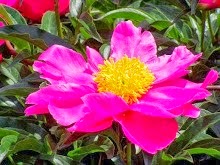
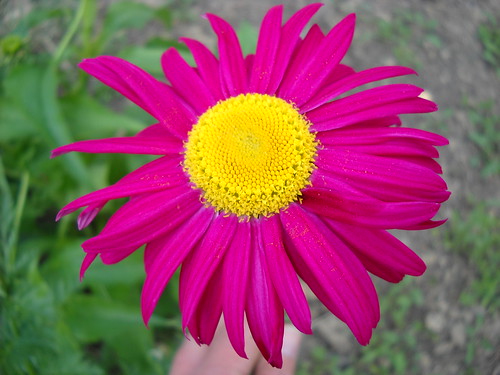
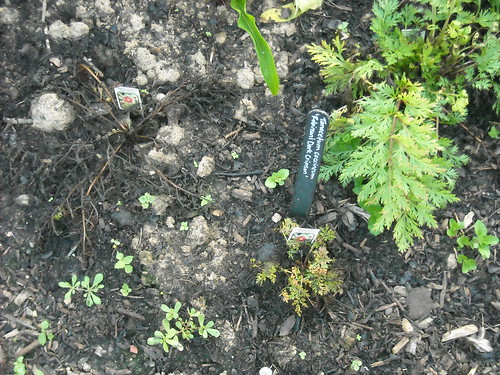
 I decided to make a few changes in the ornamental garden. In addition to veg for the restaurant, we're growing cut flowers to sell to the floral design classes offered through the Continuing Ed. Dept. Since many of my ornamentals bit the dust last year, I decided to have a go at floral crop production. One square will be the herb garden (many of which will flavor the culinary delights in the restaurant as well as some of my own concoctions). One square will be given over entirely to cut flowers, the third will be a combination of cuts and ornamentals that made it through the winter, like this Tanacetum coccineum 'Robinson's Dark Crimson' which is more of a Dark Fuchsia but I say any flower that comes back this cheerily after being buried under 36" of snow can change its color if it wants to!
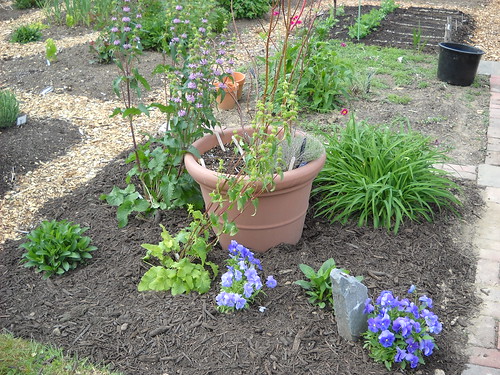
 The final square will remain ornamental as the perennials and biennials I planted last year are finally showing off. The Cercidiphyllum japonicum previously in this square was given to my housemate, who planted it at his home in neighboring Lancaster County (may the scent of cotton candy always inspire fond memories of me!).
I relocated my container to fill the void and removed the winter greens. Note to self: wear gloves when handling Holly leaves. Some of the cut Cornus branches rooted and leafed out so they're staying. The thyme also regained its variegation and one of my esteemed classmates tells me the Muhlenbergia capillaris is a slow starter so I'm giving it time to wake up before deciding whether or not it gets shovel-pruned. I plan to sow some Sweet Pea seeds in the container and let them ramble up the Cornus. Just to mix things up, I'm toying with the idea of combining annuals with herbs and a veg or two.
And just look at these guys!
 These Pansies are no pansies! Who knew such a dainty flower could be so hardy!? These were leftovers from our Greenhouse Management class last summer. Most of those crops were sold at the end of the term with our mums, but there was enough left to share and plant in our gardens.
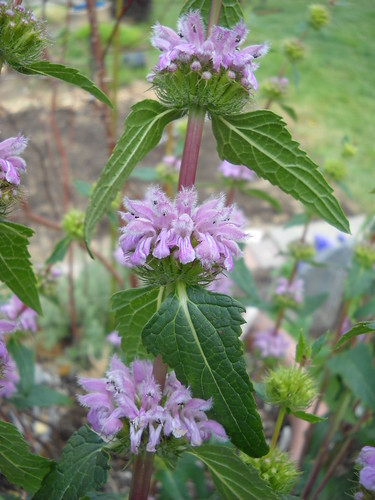
And here's another pleasant surprise: the Phlomis tuberosa 'Bronze Flamingo' decided to show up after all! I started with three; one croaked, one was seriously set back by last summer's rain and is still lagging behind this one, which seemed to be doing just fine until the 40 mph winds that came through yesterday. I fear it will develop a permanent tilt.
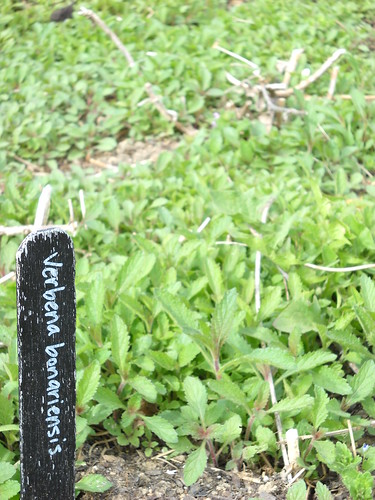
 I also discovered what happens when you don't deadhead Verbena bonariensis: you weed Verbena bonariensis. For weeks!
 We still have about a week or so before the last frost date so I'm concentrating on prepping the beds for the cut flowers and planting out the veggies that will tolerate lower temps should they surprise us. The extended forecast calls for mild temps with some showers here and there, so I'm pretty optimistic that my garden will grow quite well this year.

These Pansies are no pansies! Who knew such a dainty flower could be so hardy!? These were leftovers from our Greenhouse Management class last summer. Most of those crops were sold at the end of the term with our mums, but there was enough left to share and plant in our gardens.And here's another pleasant surprise: the Phlomis tuberosa 'Bronze Flamingo' decided to show up after all! I started with three; one croaked, one was seriously set back by last summer's rain and is still lagging behind this one, which seemed to be doing just fine until the 40 mph winds that came through yesterday. I fear it will develop a permanent tilt.
I also discovered what happens when you don't deadhead Verbena bonariensis: you weed Verbena bonariensis. For weeks!We still have about a week or so before the last frost date so I'm concentrating on prepping the beds for the cut flowers and planting out the veggies that will tolerate lower temps should they surprise us. The extended forecast calls for mild temps with some showers here and there, so I'm pretty optimistic that my garden will grow quite well this year.
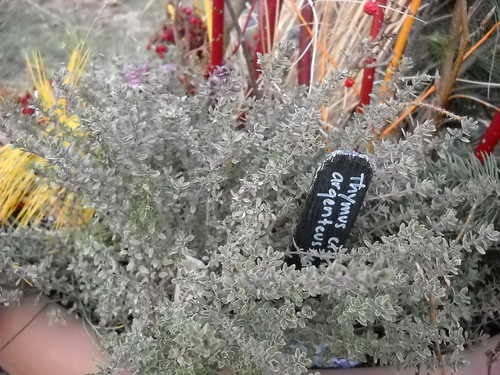
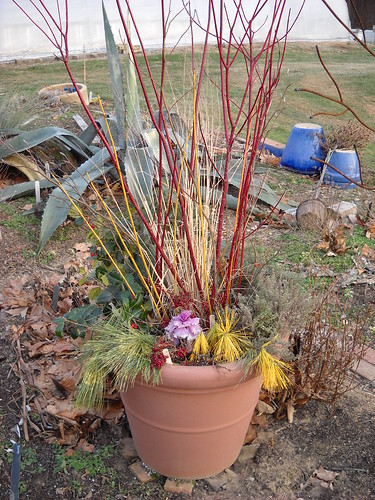 I decided to keep a few of the perennial plants in the container, such as the Muhlenbergia capillaris, Thymus citriodora argenteus variegata, and the purple Brassica oleracea.
 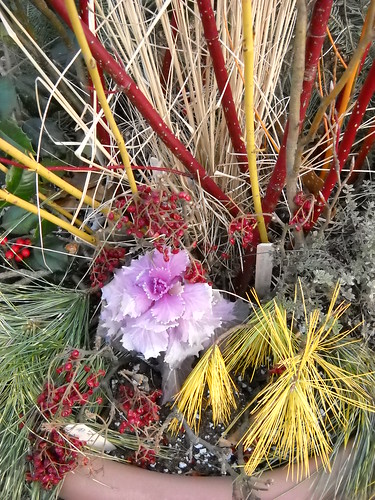 Added to the mix are the sanguine stems of Cercis alba 'Bloodgood', and the sunny stems of Cercis cericea 'Aurea'. The Pink Muhly looked better before the Big Snow; the seed heads were denser and provided a nice feathery pink haze to blur the rigid Dogwood stems. Playing off the red and yellow theme, I added a few sprigs each of Pinus strobus 'Hillside Winter Gold' and Viburnum hupense (shamelessly scavenged from my housemate Gavin's leftovers). Toward the back I tucked in some Picea pungens glauca, compliments of the lovely tree growing next to my house, and a bit of Ilex opaca for its glossy dark green leaves. Besides, what says 'winter' more than a sprig of holly with its bright red berries?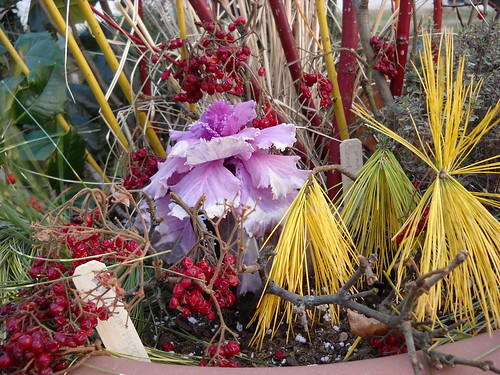
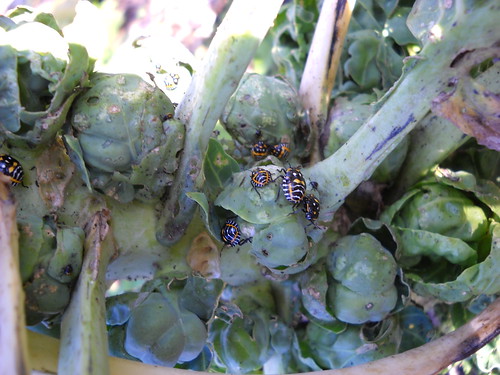
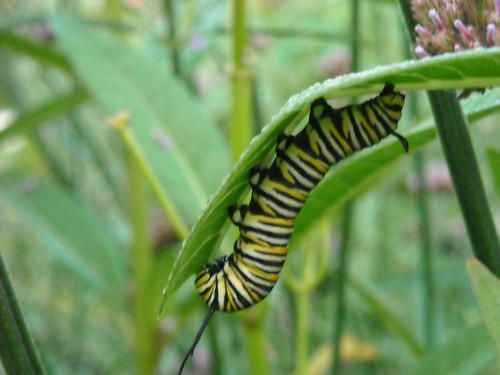
 Only a few herbs and the artichoke are still going strong although I've yet to see one flower head on the artichoke. I can't decide whether to leave the few cabbages. I'm told the flowers attract over 20 species of lepidoptera, but some of those are bound to be crop eating savages! Decisions, decisions.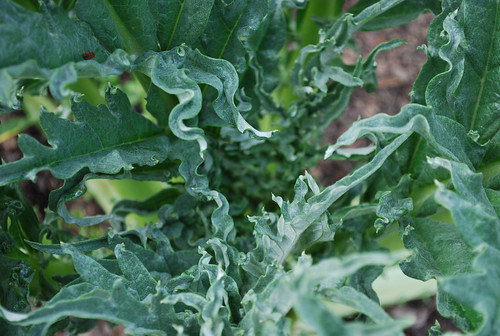

 Probably my favorite part of the container is the Salvia discolor, which I grew in my garden in LA. Back there it would have started blooming in the spring and wouldn't stop. Here, it didn't start blooming until a few weeks ago. In LA, the Black Sage went from a 4" pot to a froth of bloom in a few months. Here, it's still a little spindly and not very full, so I'm eager to see how it overwinters and what it does its second year. Fun stuff, this gardening in another climate!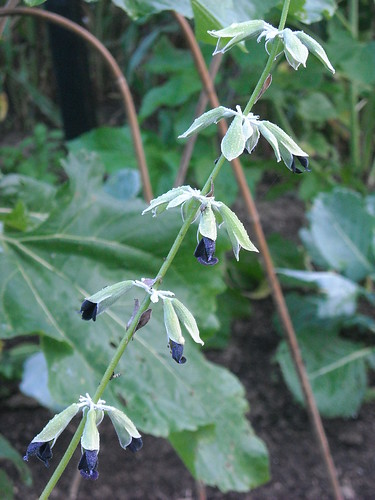

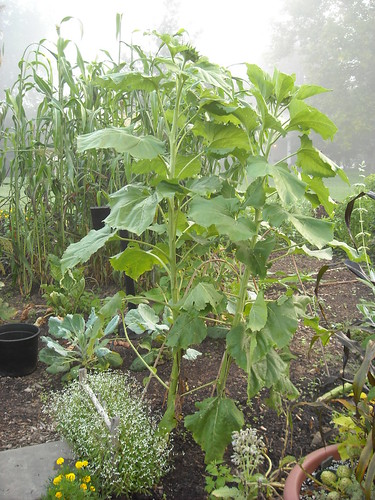
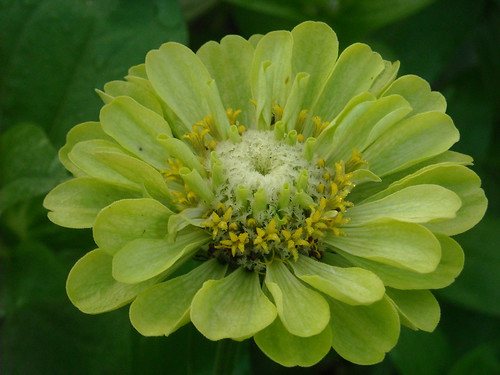
.JPG) And the fireworks were pretty spectacular...
And the fireworks were pretty spectacular... After the storm blew through, I wandered out to inspect the damage and found most of my garden submerged (yeah, I planned that moat...cough...).
 Even C.B. joined me in surveying the carnage and had a hard time finding a way to ford the stream.
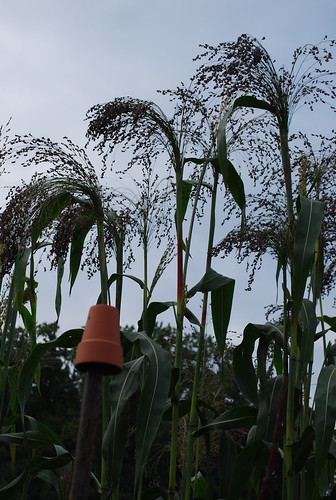
  Most plants made it through and even the corn - which was literally blown sideways - righted itself in a matter of days, but my beautiful Borage bit the dust. I had hoped it would perk up once the soil had a chance to dry a bit, but it gave up and went to that great nursery in the sky. In its place I've planted some variegated Sage and Lemon Verbena, but I'll miss the bees buzzing happily in the pretty blue blossoms.
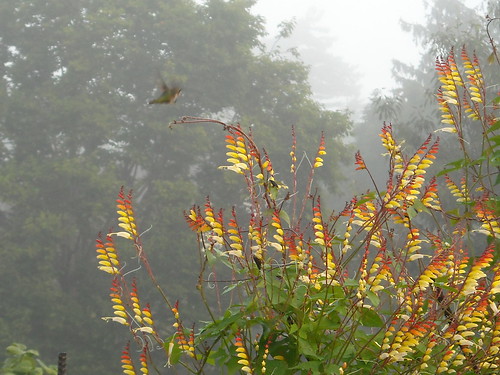
 Early one morning I stood and admired how the Mina lobata erupted into flame as the sunlight touched the garden but noticed more damage. The sturdy Mina weathered the storm like a real trooper, sticking out multiple tongues of floral fire in a botanical raspberry at Mother Nature, but it looked a little wiry around waist high.
 And I said to myself, "Oh, deer..."
 Looks like I'm going to have to hire my classmate, our resident deer hunter, to hide out in my corn maze with his trusty bow and arrow to protect my garden. The deer love to graze their way through, nibbling succulent stems down to nubs so that we have virtually nothing left to show for our gardening labors.
 Finding ways to foil the deer is one thing, but for the next couple of days more isolated thunderstorms are predicted which means a soggy garden. I can't very well put umbrellas over every plant so I guess the only thing a gardener can do with Mother Nature is weather it out (bad pun intended) and hope it doesn't stay wet for long. Fingers crossed!
.JPG)
 On the southwest side, another nursery gift, the Cercidiphyllum japonica, takes center stage. This tree will eventually reach 40' - 60' in height and width. We saw a jaw-dropping specimen at the Morris Arboretum that could easily house a Swiss family of Robinsons. It is reputed to have spectacular fall color and the scent of caramel or cotton candy. Since this tree was unknown to me until I came to PA, I can't wait to find out!
 The northwest lot is the wild child, which I tried to keep somewhat contained with a boundary of Marigolds.

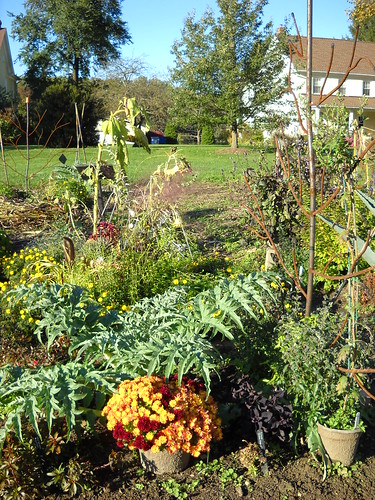
 Probably my favorite corner is the Herb Garden. Surrounding the container garden are a variety of herbs, some of which I'd grown before, some not.
 The Borage were a gift from my new friends the Rebers, and had self sown in their garden. Now that they've filled out and are bedecked with lovely blue flowers, they absolutely throb with bees. The Fennel was intended to attract butterflies and their larvae but I've yet to find any. Meanwhile I enjoy the feathery texture and sunny blooms.
 The Chamomile is in full bloom and the Stevia is happy as can be. I've been using Stevia powder to sweeten my coffee and tea for ages, so I'm interested in learning how to harvest the plant for its sweetening abilities.
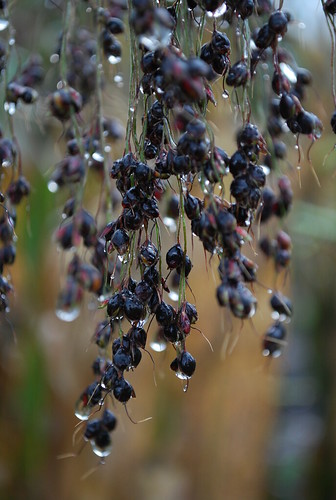
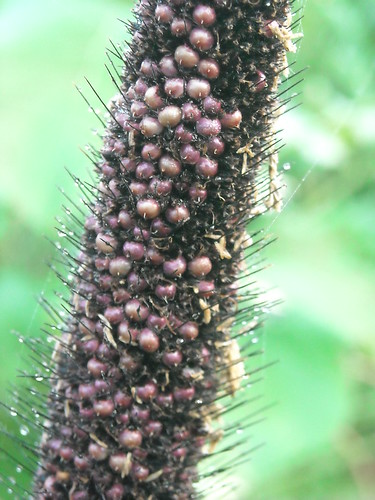
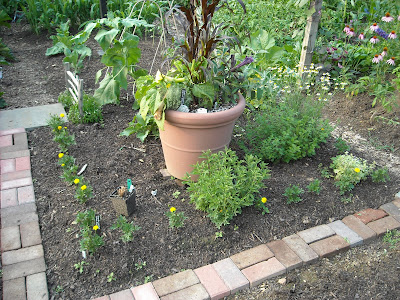 In the container, the smoky foliage of the Pennisetum glaucum 'Purple Majesty' plays well with the two Datura (one dark, one light) and the Salvia discolor.
  A couple of container tomatoes succumbed to the deer but the variegated silver Thyme has moved in to fill the void.
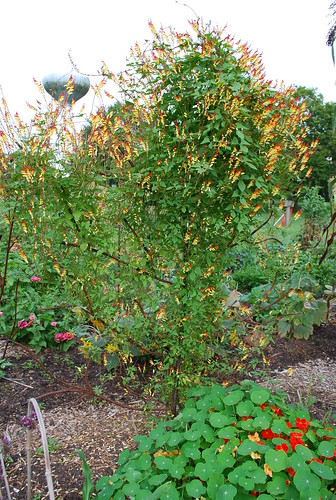
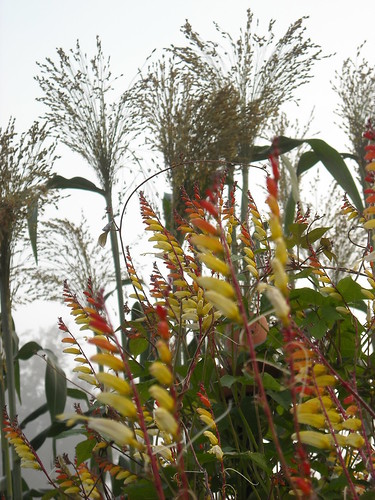
 One of my favorite ornamentals, which is actually in the veg garden, is this Mina lobata, also called 'Firecracker Vine' or 'Exotic Love Vine'. I first saw it at Great Dixter in England and knew right then and there I had to have it. I bought seed from Dixter's shop and voila! A bit of England in my garden. The inflorescence starts off with the colors of the sunset that fade to pale cream as the flowers mature. The hummingbirds adore it, but so does Bambi and friends.
.JPG)
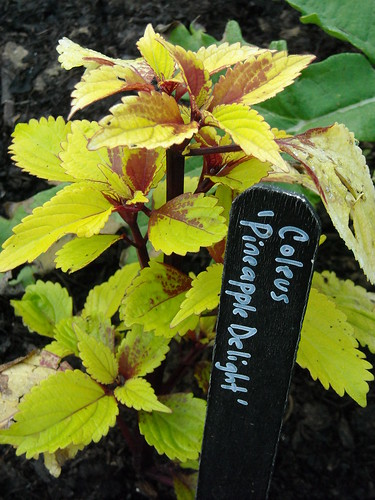
 As the student gardens are meant to be teaching as well as learning gardens, labels are a mandatory accessory. The only rule was that we had to have them, what we made them with was entirely up to us. Shannon used pieces of cork, Gavin used seed pods from the Kentucky Coffee Tree and a silver Sharpie, Steven paid exhorbitant sums for fancy copper labels, Suzanne made hers on the computer and laminated them. I recalled the black plant labels I saw in the garden at Coton Manor and how sharp and sophisticated they looked. They also blended into the background during the winter months and weren't as obtrusive as glaring white labels. Another bit of England I had to have! Apparently, only England sells them because I couldn't find a US distributor so I did the next best thing and bought a can of black spray paint. Several painted wood stakes and a white paint pen later, I had labels!
.JPG)