Pages

Showing posts with label Roman gardens. Show all posts

28 April 2014

Floralia

If spring's bounteous bloom has you giddy at the long-awaited break from a long, hard winter, no doubt you're looking for reasons to keep the giddiness going. Although May is already upon us you can still have your spring and celebrate it, too!

This week, why not dig back to your Ancient Roman roots and celebrate Floralia? And really, who wouldn't enjoy a six-day festival honoring the goddess of flowers right on the heels of Vinalia (the Roman festival of the wine harvest), though I suspect things could get a bit out of hand. All in moderation, people, all in moderation.

Because Ancient Romans believed these things, there were gods and goddesses for just about every occasion and situation. Flora, the goddess of flowers, vegetation, and fertility, was one of the most ancient. She even had her own priest, the flamen Florialis (they really liked alliteration, those Ancient Romans).

Triumph of Flora by German artist Tiepolo (c. 1743), based on Ovid's description of the Floralia
Gladiatorial games, dancing, feasting, licentious behavior, and the flinging about of vetches, beans, and lupins were the hallmarks of the festivities, which began at the end of April and ended in the beginning of May. Naked putti were optional. If you should choose to emulate these celebrations and your neighbor peers at you over the fence with arched brows as you prance around a May Pole wearing a diaphanous gown, pelting him with members of the Fabaceae family, don't say I didn't warn you. Personally I think the Romans seized on every opportunity to be naughty and Floralia was another excuse to throw a party. After the winter we've had, I can't say I blame them.

Even Erasmus Darwin, Charles's physician grandfather (who was also a natural philosopher, physiologist, slave-trade abolitionist,inventor and poet), used an image of Flora as the frontispiece for his lengthy poem, The Botanic Garden, written in 1791. By inserting Flora into his work as metaphor for the science of botany, Darwin was using ancient mythology to connect modern readers with science, popular culture, literature, and art history; all things the best gardeners I know are curious about. Unlike modern day counterparts, Darwin's Flora is assigned a minion of Gnomes to do her bidding and assist Spring in its debut:

"Oh, watch, where bosom'd in the teeming earth,
 550 Green swells the germ, impatient for its birth;
      Guard from rapacious worms its tender shoots,
      And drive the mining beetle from its roots;
      With ceaseless efforts rend the obdurate clay,
      And give my vegetable babes to day!
      And steps celestial press the pansied grounds.

Midsummer Eve by Edward Robert Hughes, c. 1908

After the brutal winter the east coast has had, I'd say spring was definitely 'impatient for its birth' and now that it's here, why not celebrate it? Perhaps we don't in the way the Ancient Romans did, but we still celebrate it in our own Western way. Do you think it's a coincidence that Earth Day is at the end of April? Or that blooming plants and flowers are exchanged at Easter and Mother's Day? Something to make you go, "Hmmm....".

If the saying 'the earth laughs in flowers' is true, then it is positively cachinnate with mirth. Hot colored daffodils, iris, and forsythia, cool magnolias, crocus, tulips, blushing cherries and snowy (ugh) white crab apples, fresh green leaves in the trees and carpets of grass are all arrayed in their spring finery. Plant a kitchen garden and grow some 'vegetable babes', or visit a local botanic garden (just be careful not to 'press the pansied grounds'). What better time to go outdoors and celebrate spring!

Or, if you're stuck inside by rain like I am, you can try to identify all 500 plants in this painting!

Primavera or Allegory of Spring by Botticelli (1482). Flora is second from right. Sources say up to 500 plant species are depicted in the paining, with 190 different flowers. Of these, 130 have been specifically named. How many can you find?
Happy Floralia!

04 June 2013

When in Rome, Part III


It's Tornado Season here in the Mid-South and a series of murderous storms has recently battered Oklahoma. Thanks to the modern marvel that is social media, home videos and photos of the deadly tornadoes allow you to witness the calamity and share in the misery of those affected from the safety of your own mobile device. We've become a society so reliant on recording events via cell phone that I fear we'll lose our ability to observe and relay information any other way. Why worry about being able to describe something when you can hold out your phone and show a picture?

Now imagine if you could read an eyewitness account of, say, the eruption of Mount Vesuvius in 79 A.D. written with perfect clarity 25 years after the event? Well, you can, and that should really blow your mind (no pun intended). If you studied the classics you may have heard the names Pliny the Elder and Pliny the Younger. The elder Pliny was an author, naturalist, and natural philosopher. In his spare time he was also the naval and army commander of the early Roman Empire and personal friend of the emperor Vespasian. He died on that volcanic day, leading his ships on a rescue mission to save the people on the coast from the disaster. Many of them survived, he did not.

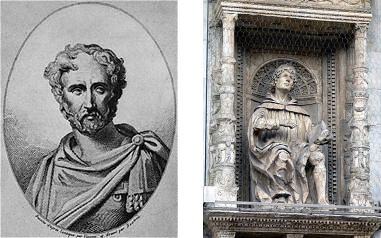
pliny both
L: Pliny the Elder R: Pliny the Younger (wiki)

Gaius Plinius Caecilius Secundus, the younger Pliny, followed his uncle into the service of the Roman court. He was a lawyer, magistrate and author, raised and educated by his uncle who no doubt taught him the art of observation in his natural studies. He was staying at his Uncle's house on the northern tip of the Bay of Naples when the mountain exploded. He was 18 years old. Imagine the impression such a spectacle would make. In a letter to the historian Tacitus, penned some 25 years later, he describes the early stages of the eruption:

"My uncle was stationed at Misenum, in active command of the fleet. On 24 August, in the early afternoon, my mother drew his attention to a cloud of unusual size and appearance. He had been out in the sun, had taken a cold bath, and lunched while lying down, and was then working at his books. He called for his shoes and climbed up to a place which would give him the best view of the phenomenon. It was not clear at that distance from which mountain the cloud was rising (it was afterwards known to be Vesuvius); its general appearance can best be expressed as being like an umbrella pine, for it rose to a great height on a sort of trunk and then split off into branches, I imagine because it was thrust upwards by the first blast and then left unsupported as the pressure subsided, or else it was borne down by its own weight so that it spread out and gradually dispersed. In places it looked white, elsewhere blotched and dirty, according to the amount of soil and ashes it carried with it."

Artist's rendition of the eruption of Mount Vesuvius as described by Pliny the Younger.
["The Eruption of Vesuvius as seen from Naples, October 1822" from V. Day & Son. In G. Julius Poullet Scrope, Masson, 1864. Historical Draw from George Julius Poulett Scrope (1797-1876)].

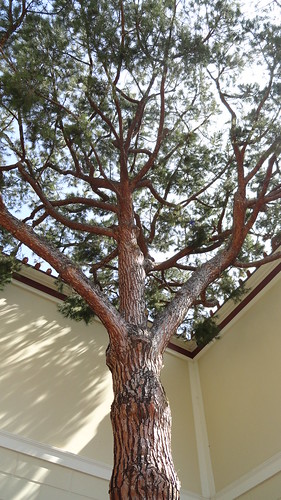
Notice he described the ash plume as being "like an umbrella pine, for it rose to a great height on a sort of trunk and then split off into branches". It's this description that is the reason for the umbrella pine in the herb garden at the Getty Villa. The Villa is impressive not only for being an art museum housing Getty's vast collection of ancient Greek and Roman antiquities, it's also an architecturally accurate replica of a 1st century Roman villa, with gardens composed of historically accurate plants, right down to the herb garden.


033 - Copy (3)
The umbrella shaped canopy of Pinus pinea (2013)

115 - Copy (3)
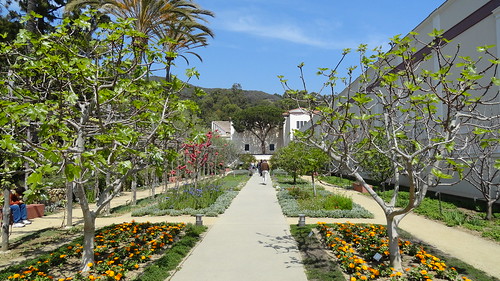
The Getty Villa herb garden, with the Umbrella Pine, also called Stone Pine, at the far end. (2013)

The herb garden was created to resemble a working garden as it would have been 2,000 years ago. While the climate in So Cal allows for genus from all over the world to thrive, Getty chose only historically accurate plants that would have been found in a Roman garden. Not only were these plants useful for food or medicine, many of them had sacred associations cherished by the people of that ancient culture. Here's a run down of just a few that I saw growing at the Getty Villa:

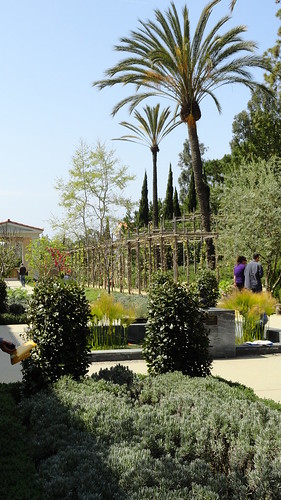
The Stone Pine, apart from being the basis of Pliny's description of the volcanic eruption that so dramatically destroyed Pompeii and Herculaneum, is the source of pine nuts, and was considered by the ancient Greeks to be the property of the sea god Poseidon since they grow on the sea shore and the lumber was used for ship building. At the Getty Villa you can pretend you're a very rich Roman, because if you were a Roman of the Pliny's standing, and you had a seaside villa, you would have had an Umbrella Pine in your garden.


041 - Copy (3)

The date palm (Phoenix dactylifera), with their distinctive feather duster shape, is where dates come from, which can also be made into date wine. The dry leaves were used to weave baskets (beware the sharp spines on the petiole) and the trunks were hewn to make fishing boats. The genus name derives from the Greek word for the date palm used by Theophrastus and Pliny the Elder, φοῖνιξ (phoinix) or φοίνικος (phoinikos). It most likely referred to the Phoenicians; Phoenix, the son of Amyntor and Cleobule in Homer's Iliad; or the phoenix, the sacred bird of Ancient Egypt. The species name comes from the Ancient Greek dáktulos "date" and the stem of the Greek verb ferō "I bear".

117 - Copy (3)
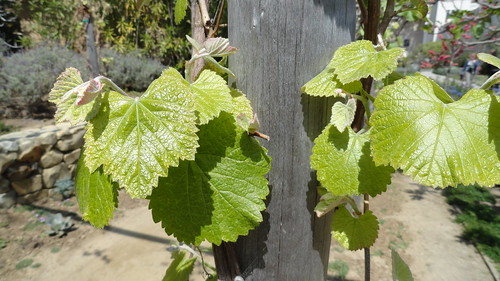
Grapes thrive in the Mediterranean and were an important food source. Conveniently, the fruit was and is ideal for making - you guessed it - wine. Those Romans did love their wine.
 
044 - Copy (3)

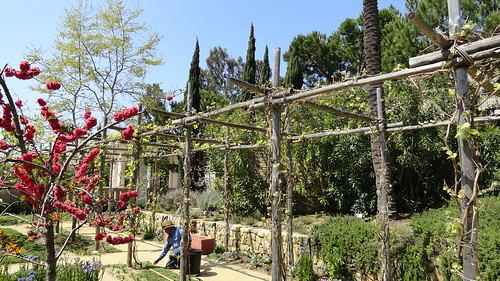
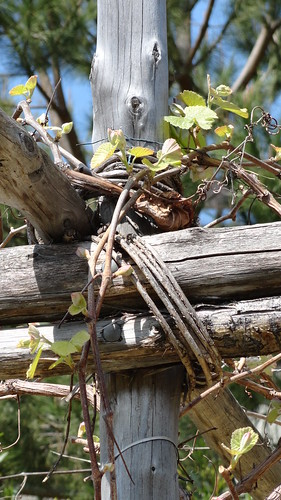
At the Getty Villa the grape arbor is made using ancient techniques such as wrapping the structure with new vines which then grow to become a living rope holding the posts and beams together.


045 - Copy (3)
Detail of the grape arbor with vines purposefully wrapped around the posts and beams. (2013)
What's that? You see metal bolts? Well, sure you do. It's the 21st century and there are liability issues with having a structure that people walk beneath in a public garden. But think about this: the Romans invented arches which enabled them to build all those impressive aqueducts, they invented concrete, they even invented the steam engine. They certainly knew how to manipulate precious metals into exquisite jewelry and lesser metals into swords, armor, and deadly accessories on chariots so who's to say they didn't also make metal bolts? Food for thought...
 
The Romans used herbs for medicine, scent, cooking, even in myth and magic. Lavender attracted bees which made delicious and healing honey. The busy little bees were also useful for pollinating the garden flowers, including the citrus trees, which were introduced to the Med by Alexander the Great.


Portrait of the Roman poet Ovid (43 BC - 17/18 AD) wearing his crown of Laurel, by Luca Signorelli (1475-1523).

Bay laurel (Laurus nobilis) was planted around homes and temples, believed to ward off lightning. Laurel wreaths were a symbol of elevated status in ancient Greece and the Romans adopted and adapted this symbolism so that it became a symbol of victory. Crowns of laurel, both real and fashioned of gold, adorned the heads of emperors, conquering generals, poets and the learned upon receiving their degrees. In fact, the French word baccalauréat comes from the Latin bacca, a berry, and laureus, of the bay laurel. The leaves are used in cooking, either fresh or dried, and make a fine seasoning for soups, stews, and pasta dishes. The phrase 'to rest on one's laurels', meaning to be satisfied with past successes, comes from the ancient tradition of being awarded the laurel crown.

In addition to a crown of laurel victorious gladiators were also given olive oil, an extremely valuable and highly prized commodity. Pressed from the edible fruit of olive trees (Olea europea), the versatile oil was used for cooking, cleaning, heating and lighting lamps.

The quince, Cydonia oblonga, native to rocky slopes and woodland margins in South-west Asia, Turkey and Iran, which were under Roman rule in the 1st century, produced an edible fruit (not to be confused with its relative, Chaenomeles, the flowering Quince) that was associated with the goddess Aphrodite. Our friend Pliny the Elder mentioned an edible variety and brides were said to nibble a quince fruit to sweeten their kiss and improve fertility. The furry leaves of lamb's ear (Stachys byzantina) was used for bandages and, if you're in a pinch, makes a very soft natural toilet paper (or so I've read).


060 - Copy (3)
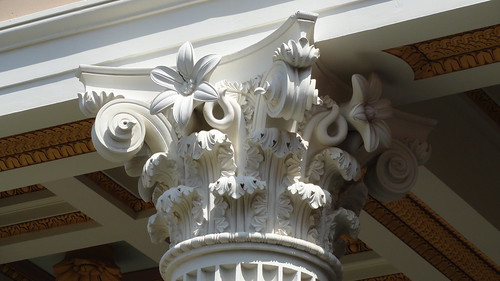
Acanthus leaves and the flowers of species tulips adorn this column at the Getty Villa (2013).

Plants and flowers were important to Roman culture and featured prominently in their architecture and decor. The leafy motif on Corinthian columns was first used by the Greeks but was adopted into Roman architecture and mentioned by Vitruvius (born c. 80–70 BC, died after c. 15 BC) in his Ten Books on Architecture. Flowers grown in the gardens were represented in the frescoes that decorated villa walls.


panorama
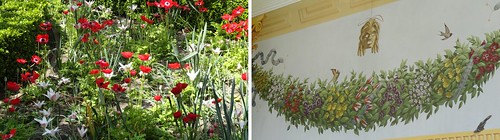
Red anemones and white species tulips growing in the Peristyle Garden are included in the frescoes decorating the peristyle walls (2013; click to embiggen).
These give just a taste of the kinds of plants, their uses and associations in Roman times. For a comprehensive list of the plants found in the Getty gardens, visit the Getty Villa website. Nature was undoubtedly a familiar entity to the Romans, and was well observed as is evident in ancient writing (take the Song of Songs, for example).
 
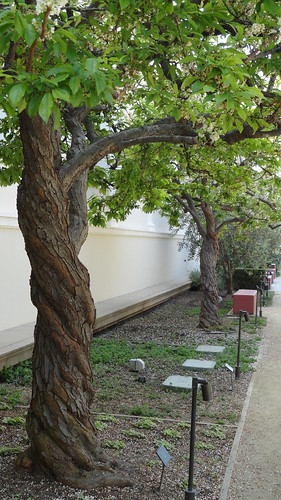
It would be interesting to travel into the future and see how many of the eyewitness accounts of our modern disasters survive, and the information they contain. Would they just be images and some media text full of facts and figures, or will someone write it down some years later, recalling details and using elements of nature to describe them? As I was reviewing my photos for this article, I couldn't help noticing that the twisted trunks of these plum trees looked like tornadoes, rising from the ground in a tortured spiral to a spreading canopy floating above.

 
040 - Copy (3)
 
 
For information on visiting the Getty Villa, visit their website. For more on the design and use of Roman gardens, see gardenvisit.com. And if you live in the Mid-South USA, heed the warnings and be careful when those storms hit!

18 May 2013

When in Rome, Part II

103 - Copy (3)
 
Ancient Rome! My tutor wrote that 'the Empire was marked by extravagant excess with intervals of reform, brilliance, chaos, madness and terror.' The Roman Empire was fabulous for absorbing elements of other cultures and making them Roman. Etruscans, Greeks, Egyptians and all sorts lent their cultures to the Romans. Anything goes, as they say. The Doctor described it as being like Soho, only bigger. At its height the Empire spread across most of modern day Europe, Northern Africa, and the Middle East.

This map shows the greatest extent of the Roman empire c117 AD
(attrib)
As they went forth and conquered, so they also revered, and the religious traditions and figures of other cultures were added to the Roman melting pot. Greek gods were given new Roman names and just as Egyptian pharaohs were viewed as deities, Caesars likewise became gods. There appeared to be a god for every occasion, necessitating the building of temples and shrines, which festooned the Roman cities, towns, even the roads. Suburban homes had household gods, a resident spirit (genius) associated with a particular place (loci). Mixing the original Latin with English, 'the genius of the place' becomes a familiar term to students of landscape design but rather than invoking the ancient Roman philosophy, modern practitioners are most likely quoting 18th century poet Alexander Pope who admonished designers to "consult the genius of the place in all"*.

The Getty Villa does a fine job of honoring the genius loci in its design. Nestled in a narrow coastal valley, with a climate very much like that enjoyed in the Gulf of Naples, it combines elements of Roman villa and town gardens that look and feel as much at home in Southern California as they would on the Neapolitan coast.

Plan of the Getty Villa 1. Atrium; 2. Inner Peristyle Garden; 3. East Garden; 4. Outer Peristyle Garden; 5. Herb Garden; 6. Amphitheatre (sunset.com)

Roman villas were essentially country retreats for the wealthy elite. Thanks to Pliny the Younger's letters, we have a good idea how these villas were used and decorated. Getty did such a splendid job of siting and designing his Villa that Pliny's description of his own could very well apply to both:

You are surprised that I am so fond of my Laurentine...but you will cease to wonder when I acquaint you with the beauty of the villa, the advantages of its situation, and the extensive view of the sea-coast...The courtyard in front is plain, but not mean, through which you enter porticoes...enclosing a small but cheerful area between...The gestatio [an avenue for exercise either on horseback or in a horse-drawn vehicle] is bordered round with box, and, where that is decayed, with rosemary." (Letter XXII to Gallus)


066 - Copy (3)
The Outer Peristyle Garden looking out to the Pacific Ocean (2013)

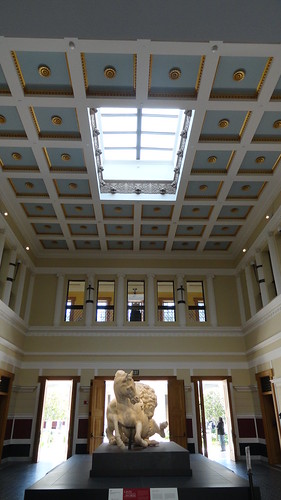
Dwellings in towns such as Pompeii and Herculaneum were walled and generally without windows for privacy, security, and to keep out the stench from the streets. Practically all houses had gardens, even the most humble. If you were rich, you had several. Upon entering the home of a Roman town dweller you would find an atrium, a family space in which the central portion of the roof is open to the sky for ventilation. There might also be a corresponding basin formed in the floor beneath to catch rain water.
 
 
076 - Copy (3)
The Atrium at Getty Villa. The floor basin is covered by this sculpture. (2013)

Beyond the atrium is the peristyle, a paved enclosure surrounded by columns. The open space permitted fresh air into the house and illuminated the rooms surrounding the peristyle court. At Getty's Villa plants, flowers, and fountains decorate the court just as they did in the original at Herculaneum. The playing fountains and birdsong soothe the senses, imitating nature in an artfully contrived setting. The cool shade of the marble corridors give relief from the midday sun and make this a place one would want to spend a day in repose, away from the noise of the city. 

078 - Copy (3)
View of the Inner Peristyle Garden from within the Atrium (2013)
 
These corner fountains are replicas of those found in ancient Roman ruins (2013)

In the first century B.C., the Roman architect and writer Vitruvius dedicated his treatise on architecture and design to the Roman Emperor Augustus. He put forth the idea that design must incorporate the qualities of firmitas, utilitas, and venustas – firmness (technology), utility (function), and delight (aesthetic beauty). His prescription for a peristyle was quite specific:

Peristyles, lying athwart, should be one third longer than they are deep, and their columns as high as the colonnades are wide. Intercolumnations of peristyles should be not less than three nor more than four times the thickness of the columns. (Vitruvius, The Ten Books on Architecture).
 
Romans were nothing if not big on regularity.

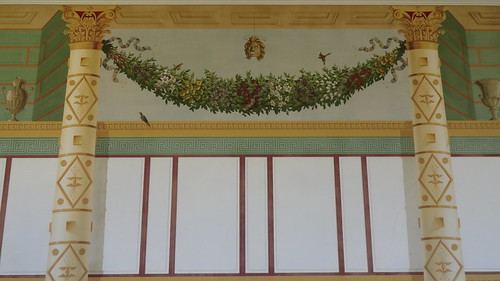
If your station in life prohibited such columned extravagance, you could paint a fresco on one or more walls to give the illusion of a much larger and grander garden. Even the columns could be painted on.

A garden fresco decorating the wall of a home in Pompeii (British Museum)


051 - Copy (3)
Restored fresco at the Getty Villa, Outer Peristyle Garden (2013)

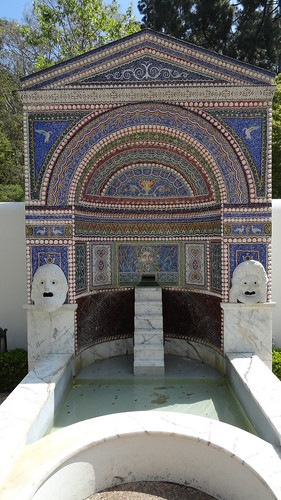
Another space for growing flowers, vegetables, and medicinal plants was called a xystus. Like the peristyle courts, the xystus might be decorated with statues, water features, or a pavilion. The East Garden at the Getty Villa is what I would consider to be the xystus, and features two fountains: one central font, raised high, and a niche fountain, replicated from one found at Pompeii decorated in a mosaic of shells and tiles. 

East Garden at Getty Villa (2013)

090 - Copy (3)
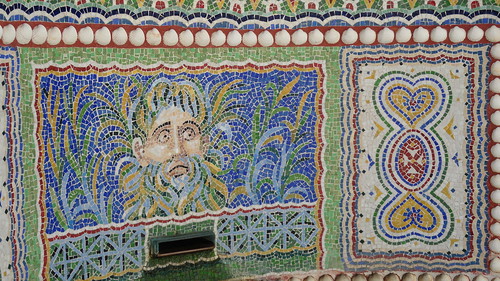
Pompeii niche fountain replica with masks of Leonidas and Pericles (2013) 
 
073 - Copy (3)
Mosaic detail (2013)

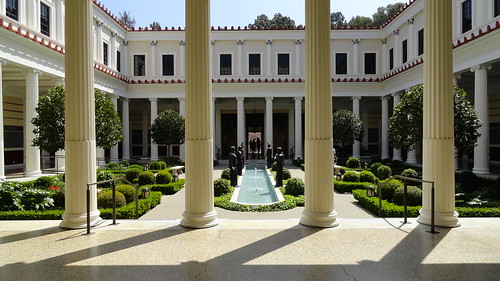
The Outer Peristyle Garden is the Villa's grandest peristyle court, with a 200-foot long pool, surrounding covered peristyle walk providing shelter from the elements, and a splendid view to the sea. The Roman love of orderliness is seen in the symmetricality of the garden and use of repeated shapes - the upright columns, rounded tree canopies echoed in shorn box balls, the placement of statues and busts on plinths, even the rectangular arches formed by the peristyle repeat, drawing the eye around the site. The dominant color here is green with a few accents making this a calming, soothing space where the villa owner can escape hectic Roman city life.

049 - Copy (3)
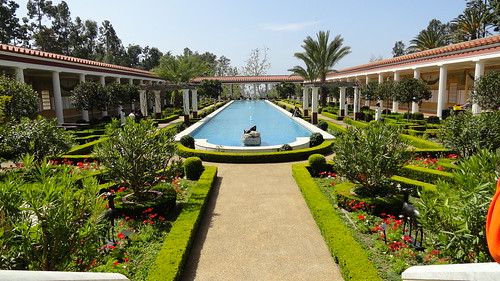
The Outer Peristyle Garden, looking east (2013)

Hold on. I almost forgot - we're not in Ancient Rome, we're in 21st century Los Angeles. If you take away the tourists with their audio guides, mobile phones, and funky modern togas, not to mention the cafe and gift shop, wandering along the shaded corridors of the Getty Villa gives you a pretty good idea what being in a real Roman villa garden was like.

In Part 3 I'll tell you about the plants in these gardens and their significance in Roman times.

If you're in London between now and September, you can pop by the British Museum and check out their exhibit on Life and Death of Pompeii and Herculaneum featuring lectures, presentations, and objects from both cities. Preserved as they were by volcanic material, much of what we know about first century Roman life was found in these important cities. For tickets and visiting hours, go to the museum website.


115 - Copy (3)
The Getty Villa herb garden (2013)
Eighteenth century poet Alexander Pope wrote many epistles with his views on garden design. The following excerpt is from Epistle IV To Richard Boyle, Earl of Burlington c. 1738, and has been quoted in countless texts on landscape and garden design:
 
*Consult the genius of the place in all;
That tells the waters or to rise, or fall;
Or helps th’ ambitious hill the heav’ns to scale,
Or scoops in circling theatres the vale;
Calls in the country, catches opening glades,
Joins willing woods, and varies shades from shades,
Now breaks, or now directs, th’ intending lines;
Paints as you plant, and, as you work, designs.


06 May 2013

When In Rome...Part I

...or, at least Los Angeles...

One of the frustrations of studying a subject like garden history is not being able to hop in a time machine and visit gardens created thousands of years ago which no longer exist. How I would have loved to have joined the Doctor and Donna* on their visit to Pompeii in 79 AD to see some of the gardens of the ancient Romans.

OK, well, maybe not, since they were there on Volcano Day.

Basically, run.

Among the villages destroyed by the eruption of Mt. Vesuvius on that fateful day was Herculaneum. It, along with four other villages, was destroyed when the mountain exploded, sending 'superheated pyroclastic material'** raining down upon it (Dr. Evil would incorrectly call it 'liquid hot mag-MA'. Yes, you just read that in his voice with your pinkie to your mouth, didn't you!). Buried beneath 20M (50-60 feet) of ash, the town was better preserved than its more famous neighbor. It was rediscovered in the early 1700's and later excavations revealed much of the city still in tact, including the lavish seaside villa belonging to Julius Caesar's father-in-law Lucius Calpurnius Piso Caesoninus. Since its rediscovery, it has been called Villa dei Papiri due to the number of carbonized papyrus scrolls found there.


Plan of the Villa dei Papiri, village of Herculaneum, destroyed by Mt. Vesuvius in 79 AD (attrib)

Fast forward several hundred years to the 20th century California seaside town of Pacific Palisades near Malibu. There, a one J. Paul Getty was amassing a fortune in oil and cultivating a keen interest in art and history. As he traveled throughout Europe, he began collecting art and artifacts from ancient Mediterranean civilizations, displaying them at his own lavish home overlooking the Pacific. Getty's collection continued to grow so in the early 1970's he decided to build a museum that would allow him to showcase it to the public in the perfect context.


The Outer Peristyle Garden at the Getty Villa (2013)

Getty consulted with architect Stephen Garrett on the design of his new museum, which he based on the plan of the Villa dei Papiri as published in Le Antichità di Ercolano (The Antiquities of Herculaneum). Nestled in a deep hillside valley, construction of Getty's Villa began in the early 1970's. Although Getty now lived in England, he eagerly oversaw every step of the process. Sadly, he died only two years after it opened, having never seen it.

The Getty Villa, as it's now called, opened in 1974, an exact replica of the peristyle garden from Villa dei Papiri. The overall campus combines architectural elements representing Roman homes from Pompeii, Herculaneum, and Aplontis, all destroyed by the volcano. Four distinct plant communities comprising about 300 varieties live at the Villa: native (to Italy), those from similar climates, So Cal and Mediterranean natives, and species that are historically accurate to ancient Rome. All give the Villa a feeling of authenticity that should characterize every historic garden recreation.


According to his architect, Getty 'had very clear views about what he wanted to achieve here. He wanted a person that came here to get some idea of what a villa way back 2,000 years ago would actually have felt like'.

Well, it seems we can travel back in time after all.

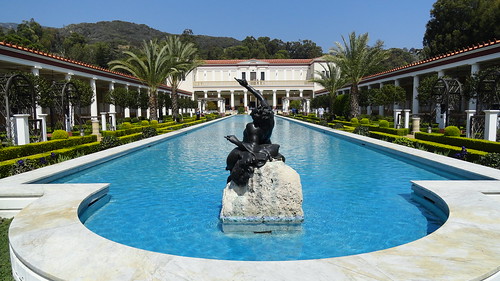
The central pool of the Outer Peristyle Garden (2013)


Stay tuned for Part II where I'll talk more about the individual gardens and how they represent the suburban gardens found in ancient Roman cities. In the meantime, enjoy this video about the History of the Getty Villa.


Admission to the Getty Villa is free but timed tickets must be reserved in advance. There is a fee for parking. For more information and a calendar of events, visit The Getty Villa website.

*Leave it to me to include a Doctor Who reference in a piece about Roman gardens! (Doctor Who, series 4, episode 2: The Fires of Pompeii)

** A pyroclastic flow is described by the US Geological Survey as ‘A ground-hugging avalanche of hot ash, pumice, rock fragments, and volcanic gas that rushes down the side of a volcano as fast as 100 km/hour or more. The temperature within a pyroclastic flow may be greater than 500° C, sufficient to burn and carbonize wood. Once deposited, the ash, pumice, and rock fragments may deform (flatten) and weld together because of the intense heat and the weight of the overlying material’.