Plants of Historic Interest in the Conservatory: OrchidsThis month in Indoor Display has been full of discovery. My latest discovery has to do with orchids and the people who adore them. Specifically, I've discovered that Orchid People are Crazy! Just saying, is all.
Not that I blame them, of course! If one is going to be crazy over something, one could certainly do worse than the largest family of flowering plants with over 130,000 varieties of crossed genera. Even people who aren't die hard
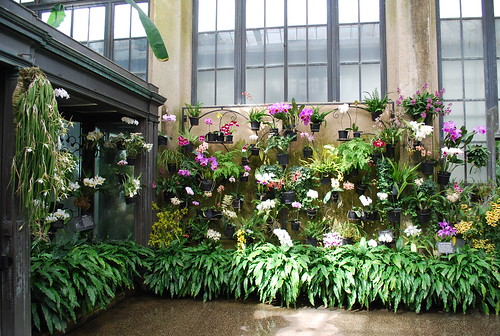
Orchis enthusiasts stop short and catch their breath when they enter the Orchid Room in the conservatory. I don't blame them for this, either. It's like walking into a floral jewel box. Delicate blooms of all shapes, sizes, and colors glow from the walls, batting their lashes and tempting us with their appearance and scent.
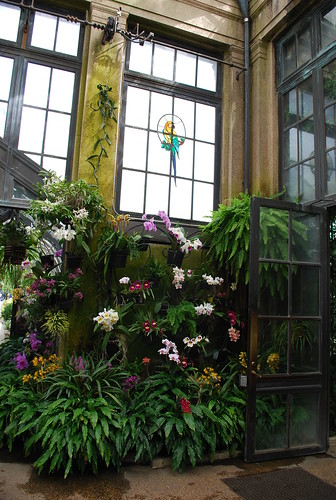
One particularly important person who was likewise entranced by orchids was Alice DuPont, Longwood's First Lady. She, along with her husband Pierre and sister-in-law Mrs. William K. DuPont, was one of the charter members of the American Orchid Society. A nearly pure white
Cattleya with a pale yellow center, lightly scented, was named after her. The orchid collection she began at Longwood grew even more when Mrs. William K.'s collection was acquired after her death, along with a gardener to care for them.
Currently there are more than 3,200 orchid plants in the collection, housed in 5 different greenhouses, each with different light, temperature, humidity and environmental controls suited to the plants contained within. At any one time, 200 - 500 plants may be on display, all at the peak of bloom. Plants in the display are changed out three times weekly. First thing in the morning, the gardener goes shopping in the orchid greenhouses, looking for the best blooms. Let me just tell you - if you're a gardener, there can be no greater thrill than wandering through a greenhouse positively overflowing with blooming plants, trying to choose the best ones to show off. I'm not much of a shopper in general, but this kind of shopping I can do all day! The chosen plants are then groomed before being put on display. Those that come out of the display are taken to the potting shed where they may be divided and re-potted before heading back to the greenhouse.
Deceit and Deception
We're not the only ones who fall prey to the orchid's allurements. Orchids, by nature, are unabashed flirts. They will do almost anything to con an unsuspecting pollinator into its clutches, all in the name of procreation. Orchids are devious, too. Once the pollinator is duped into approaching the flower's treacherous embrace, they may encounter one of several tricks or booby-traps that forces them to carry the pollen out and on to the next flower.
But let me digress and paint a short history for you. In the Greek legend, Orchis is the child of a nymph and a satyr. He was a naughty boy who spied on a beautiful priestess of Dionysus (some accounts say he tried to rape her, which fits neatly with the next part of the story). The gods were quite put out about his frenzied state and decided to teach him a lesson by sending wild beasts to tear him limb from limb. Where his testicles fell, there an orchid bloomed. Due to this association, the roots of certain orchids were thought to be an aphrodisiac, the Viagra of the 16th century.
No, I'm not making this up!
One of the things I find most fascinating about orchids is that specific species rely on specific pollinators. The flowers are constructed such that only a certain insect with a certain size body - or proboscis of certain length - can get into it, or the flowers resemble the female insect in form, color, or scent in order to lure that specific male insect in to mate. The annihilation of any of these pollinators can spell extinction for the species of orchid in the wild relying on it. Even Darwin, upon viewing the 12-inch nectar spur of the Angraecum sequipedale exclaimed, "My god! What insect can suck it!?" He hypothesized that there existed a moth with a 12-inch long proboscis which was the designated pollinator for that particular species of orchid, and he was right.
Take this guy for example - this is Catasetum fimbriatum var. morrenianum. It, like most orchids, is an epiphyte which means it doesn't grow in soil. In its native South America, it can be found growing in dry lowland regions on the trunks of palm trees. It's also deciduous, a trait that one might not think to associate with such a tropical looking plant.
Let's take a look at how it manages to use an insect to get what it wants.
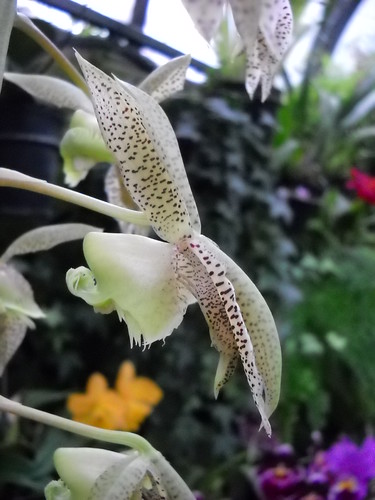
This cat blooms on pendant racemes. When you duck underneath and tell it to say, "Ahhhhhh" this is what you see.
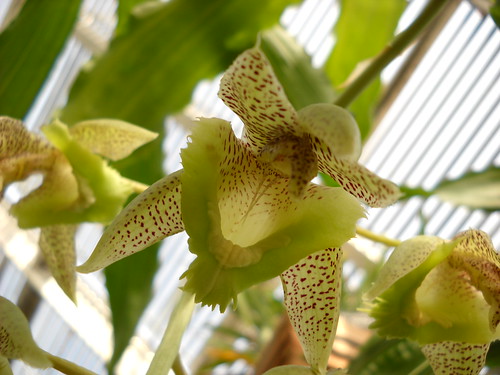
The blossom is made up of parts in threes: there are three petals but the lower petal is often fused to form a pouch. Notice the little whiskers - or cross hairs - in the back? When an insect makes its approach and starts rootling around looking for nectar, the movement will trigger the hairs.
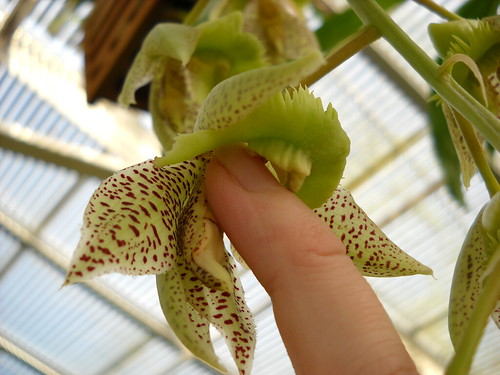
What this does is activate an ingenious mechanism by which a sticky substance is squirted onto the insect's back and then wham! the structure containing the anthers, called the column or gynostemium, is slapped onto the glue and carried away. Don't tell anyone, but I did this once with the corner of a sheet of paper and the "thwack" was clearly audible!
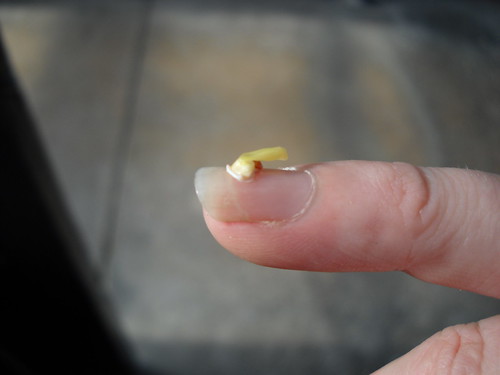
I'm very curious to know whether the unsuspecting arthropod realizes what just happened but, in any case, it probably is startled into exiting stage left and goes to the next flower, where the pollen sticking to its back is transferred to the column there. In orchids the male and female reproductive organs are fused together into a structure called a column and the pollen, rather than being a powder that can be carried by the wind, is bound in a waxy mass of two, four, or six pellets called pollinia. Next time you have an orchid bloom at your disposal, take it apart and see for yourself. Once this booby trap is tripped and the flower is pollinated, it begins to set fruit and seed and the flower dies.
Here's another one: the species Oncidium - commonly sold in grocery stores - has flowers that resemble a swarm of bees so that incumbent bees will hurl themselves at the flowers to drive the supposed interlopers off. In doing so, they pollinate the flowers. Or how about the Coryanthes species, aka "Bucket Orchid", with glands that secrete a viscous, sweet smelling fluid that fills the bucket. Bees fall into the bucket, splash about, and have to climb out through an escape hatch in the back where the pollinia are waiting.
They are shameless, these orchids! And while new species are being constantly discovered, it is mostly due to deforestation that they are being found. They are found and described about the same time they are rendered extinct.
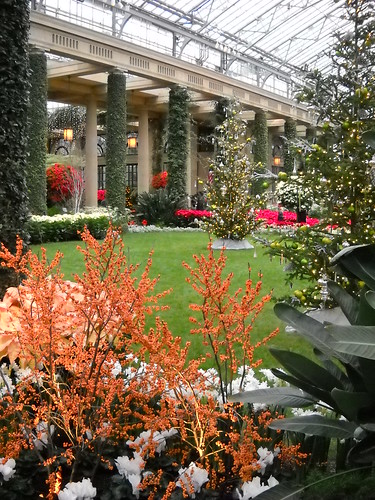
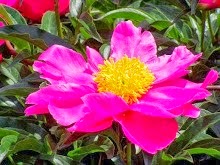
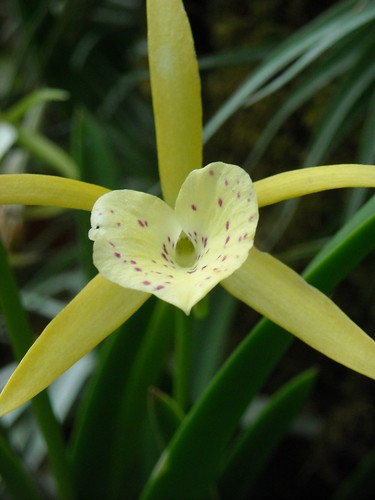
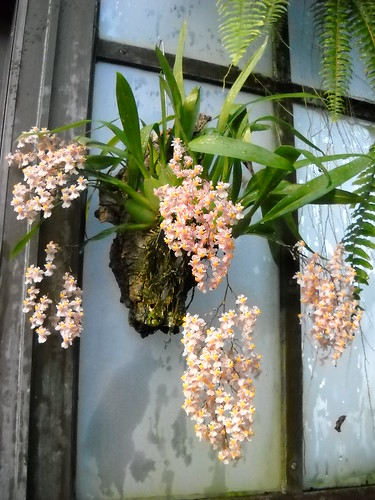
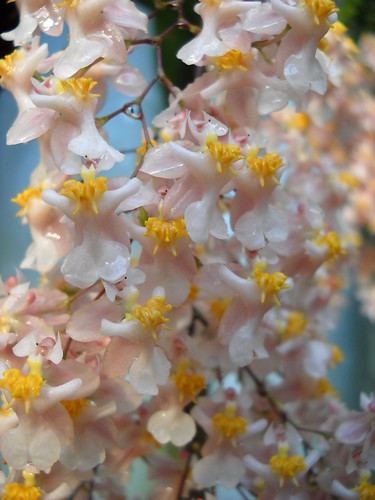
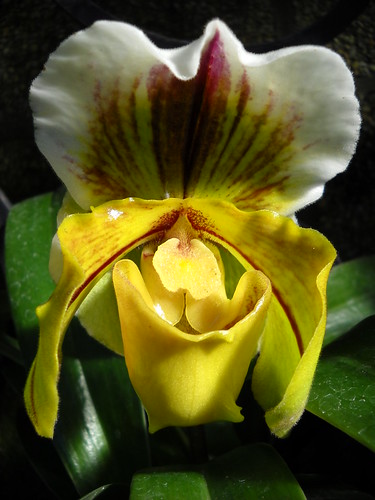
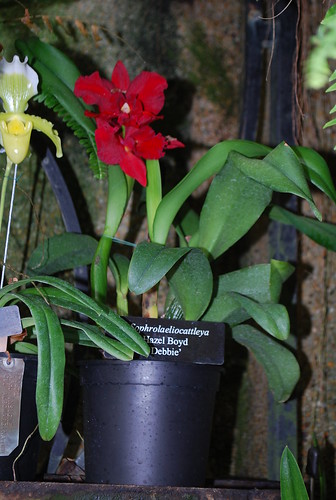
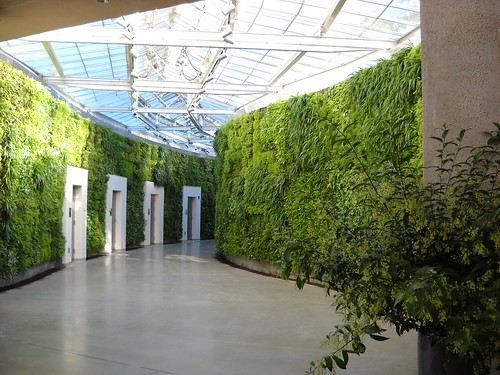
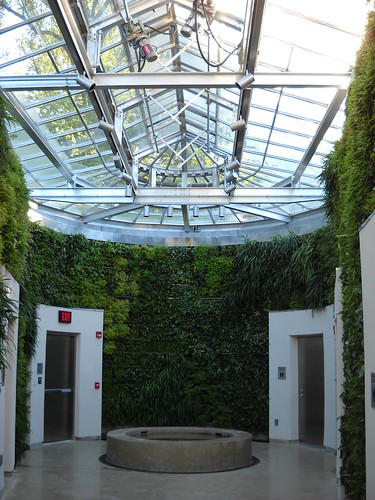
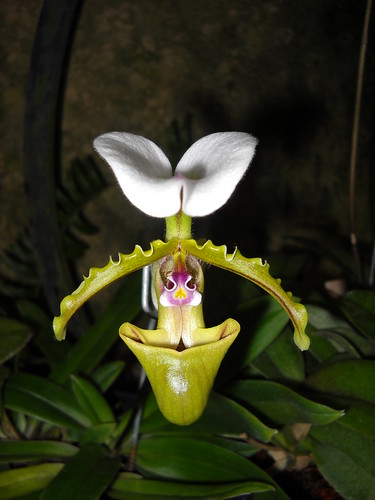
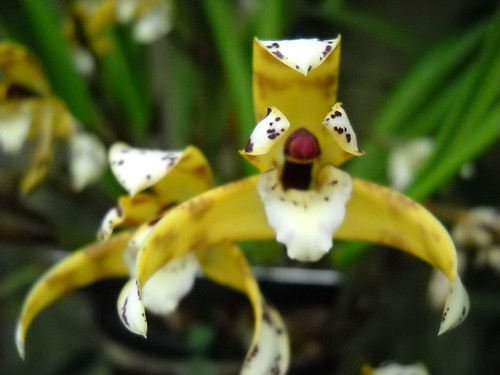
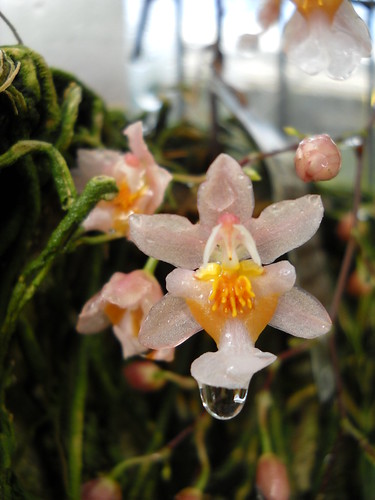
Well, that about wraps it up for orchids. I hope next time you see one you will have a new appreciation for it. Some are even edible (I forgot to tell you about the vanilla orchid...so many orchids, so little time) so after you dissect it, you can drop the pieces into your salad and enjoy it! For now, here are some photos of just a few of the many varieties on display here at Longwood.













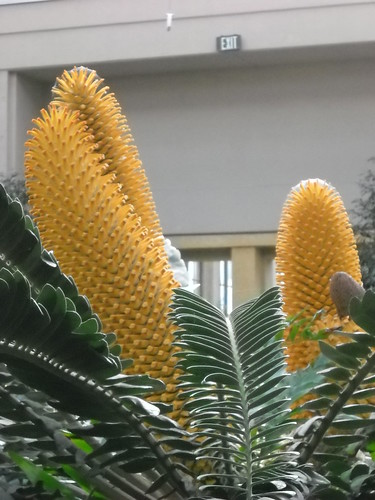
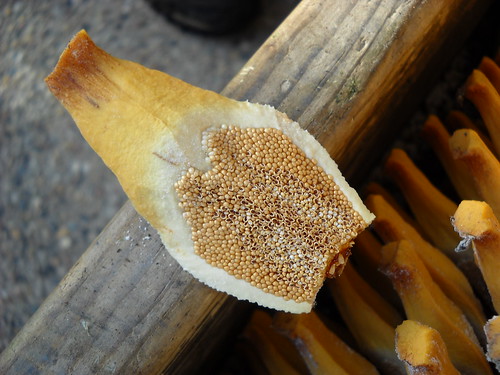
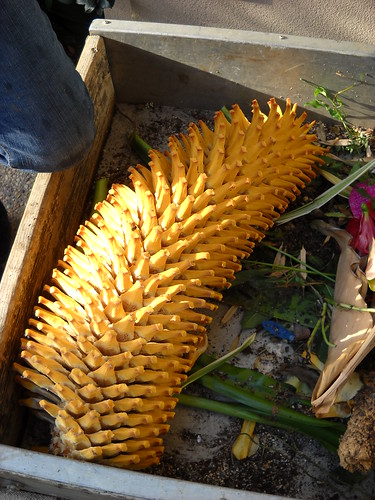 Each of the scales, or structures composing the cones, contain the sporangia which in turn contain the spores or what those who don't give a hoot about botanical accuracy might call pollen. The lower surface looks like a sponge, with lots of tiny pores. If you were to snap one off and shake it - as I did - you'll see the yellowish powder float out.
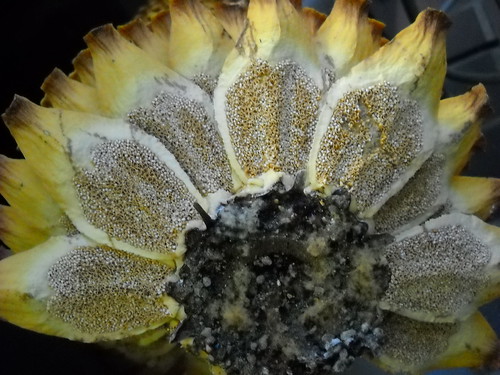
 The end of the cone where the break occurred looked like a sunflower, with all the scales arranged spirally around the axis.
 You have to admit, it's pretty cool.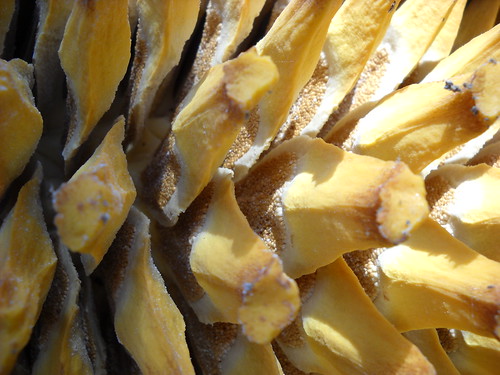
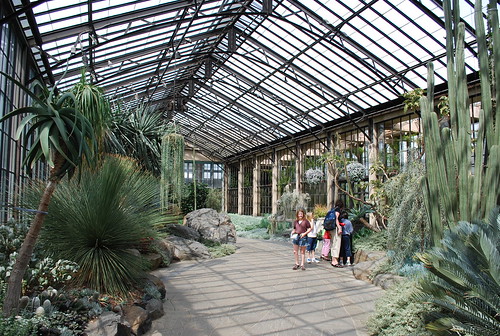
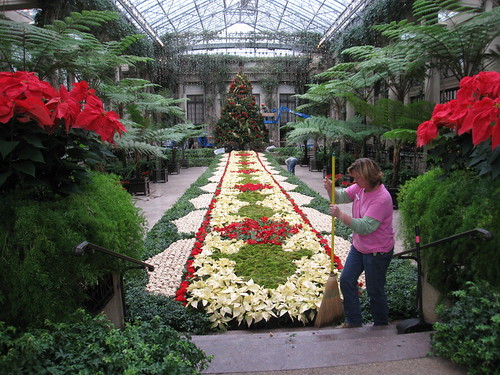 I've visited many wonderful conservatories here in the US and UK, but I never really understood them until I came here. I know that might not make sense so indulge me by trying to put yourself in my steel-toed shoes for a moment: I come from LA. USDA hardiness zone 10, lovely Mediterranean climate with warm, dry summers and cool, dry winters (the 130 year average annual rainfall for LA is 15 inches, in case you were wondering). When I arrived at Longwood for my PG interview a year ago September, I spent many happy hours wandering through the 4-acre conservatory (truth be told, I got lost in it!) but the Palm House didn't do much for me, because most of the plants in it could - and many do - grow quite happily outdoors in So Cal. They were a common sight to me and therefore weren't very interesting. Learning the history of the plants in the collections has completely changed my point of view.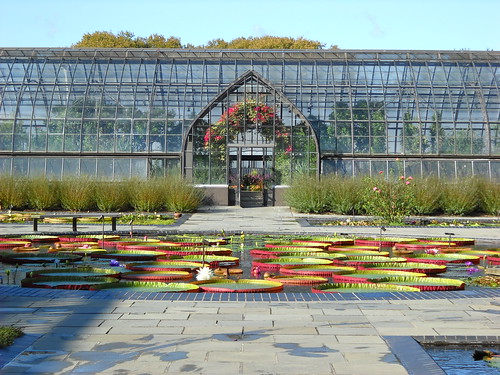
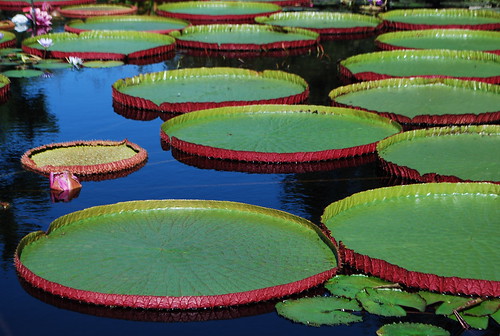
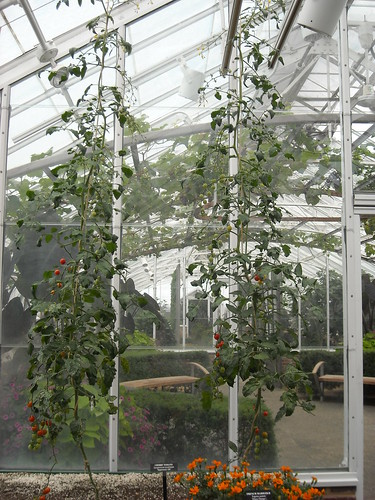
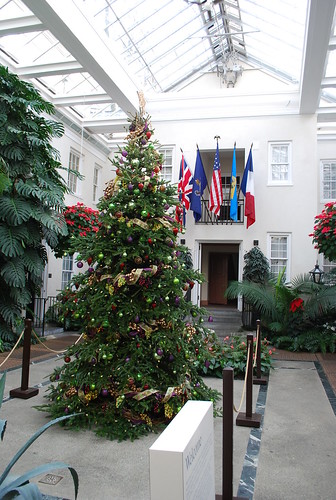 DuPont was apparently so pleased with the house conservatory that he began planning a much grander one. His vision became reality and the new conservatory was opened on November 25, 1921, using the latest technology of the time to heat, water, and power the complex. Instead of the typical jungle exotics, DuPont filled his glass house with fruits and flowers, giving it the feeling of a European orangery (the name by which a section of the Main Conservatory is still referred to today). Included in the structure were a number of smaller production houses where fruit and vegetables were grown in all seasons for the estate. Today, fruit and veg are still grown in some of these spaces in horticultural displays that are aesthetic as well as functional.
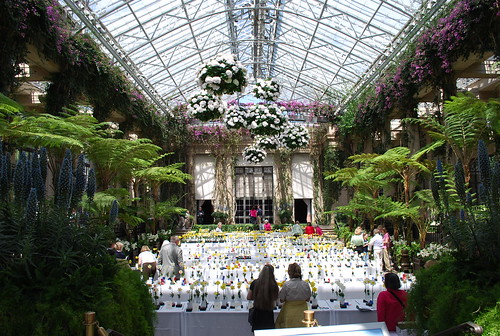
 In my opinion, the most ingenious part of the building is the Exhibition Hall floor. The area is sunken below the level of the main walkways and designed so that the floor can be flooded to hold several inches of water. The water can be drained in a matter of hours and the floor dried so that special events can be held there. Everything from plant and flower society shows to dinner events to special seasonal displays are presented. If you ever get a chance to attend a candlelight dinner on the fern floor, I highly recommend it. I can't think of a more romantic setting than the conservatory at night with the stars shining overhead. Sigh.
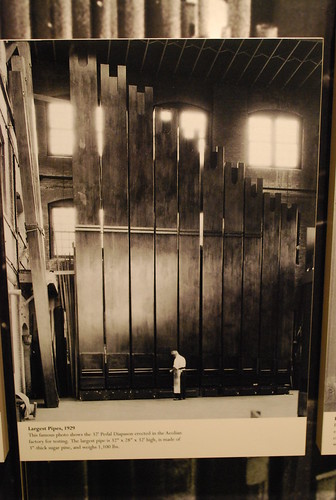
 In 1926 the Azalea House was added - now called The East - and in 1966, the Palm House. The conservatory at Longwood also houses the Music Room and the Ballroom, which is home to an Aeolian organ weighing 55 tons with the pipes installed in 9 chambers measuring 63 feet wide, 23 feet deep, and 40 feet tall. It's one of the largest residences organs in the world and is nearing the end of an extensive renovation.