My first encounter with online learning programs was while I was at Longwood. During a meeting to go over the online platform and how to use it, the instructor asked us what other platforms we'd used in the past. My answer: a chalkboard. I didn't see how an online learning program would fit into the program we were doing given the fact that all of us sat in the same classroom together each day. Why chat via web when we could simply lean over the desk and pester our classmates in person?
As first experiences go, that one left me with a bad taste in my mouth for online learning, so when garden historian Dr. Toby Musgrave asked me to review his online garden history course, I was slightly more than skeptical that it would be as good as a live classroom. I'm pleased to report my skepticism was unnecessary.
my-garden-school.com is a UK website developed by Elspeth Briscoe and Duncan Heather, both garden designers, marketing professionals, teachers, and Internet geniuses. Their goals: "to bring more high quality online training in gardening, prompted by the digital revolution, and to re-energise revenue streams for published gardening authors due to falling book sales."
Oh, this digital revolution. Lucky for those authors, I'd still rather hold a real book in my hands!
Registration is simple, as is setting up a profile and logging in to your course. You are also introduced to your classmates via their profiles and comments. Students in my class came from Canada, UK, Australia, and various points in the US. Most were enthusiasts and at least one fellow student is also a garden historian. And to prove what a small, small world it really is, a fellow Longwood student was enrolled in the course! Once the course starts - generally they run every 4 weeks - each week's lesson is available on the Saturday morning as a video lecture so you see and hear your learned instructor each week. Here's a wee taste for you:
Included in the video are photographs highlighting the lecture topic. Oh, to travel to the gardens illustrated in those weekly lessons! Actually, come to think of it, I have and there is an option on the lesson screen which allows you and your classmates to upload your own photos for bragging and sharing. There is also the opportunity to exchange messages, ideas, and ask for help on unruly technical issues via the discussion forums for each lecture. Virtually like being in a classroom but passing notes under the desk results in a pile of folded sheets at your feet.
Along with each video lesson, which can be viewed at any time during the course should you feel the need for a refresher, there's a save-able and printable transcript so you can refer back and, if you share with me an undying love of paper, highlight specific points and make your own notes. I've printed all the lesson transcripts and kept them for future reference.
But lest this online learning business seem like fun and games, there is a weekly assignment, too. I found the assignments a bit vague, but perhaps that's because I just finished quite a rigorous academic program with very particular parameters. The assignments aren't graded, per se, but the instructor does send you valuable feedback and more points to ponder. What I did like was being able to read my classmate's assignments as others always pick up things you may have missed and have different view points, experiences, and knowledge that can be shared. We encountered a few technical glitches that the site designers are working on as far as the format of files allowed for submission, and the staff have been very attentive and welcomed our suggestions for making things a bit more user friendly. Likewise, Toby is very responsive to questions, discussions, and offering suggestions for further reading, as any good instructor should be.
The lesson content is clear and well illustrated by the images. Toby's lectures are thorough given the 30 minutes - give or take - allotted and cover all the essential points, styles, and players of garden history but there is, to me, one major problem: the course is too short! Four weeks just isn't enough time to cover 3,000 years of garden history in any real depth. What can I say? I'm greedy!
If you're a professional gardener or just a garden enthusiast and want to learn more about the history of this great occupation and it's influence on culture and society but don't have time to read the volumes of garden history books out there and don't have access to a college course - and trust me, there are pitifully few garden history courses out there, an educational shortcoming I mean to tackle in the near future - and want the flexibility of studying at your own pace, on your own timetable, then this is a fantastic course to take. You will be learning with like-minded people all over the globe without the worry of embarrassment if you show up to class in your jammies.
With Christmas fast approaching, why not give yourself or a loved one the gift of learning? The next round of classes starts on Saturday!
For more information, click here or visit www.my-garden-school.com.
Special thanks to Dr. Toby Musgrave for inviting me to review the course. I've just put a couple of his books on my Christmas wish list!
29 November 2012

23 October 2012
That's Brilliant!
I just learned today that my friend Scott Daigre of Tomatomania! is speaking at next year's Philadelphia Flower Show, which I think is brilliant! I also just learned that the theme of the show is... Brilliant!
Coincidence? I think not. I'm already making travel plans, are you?
Coincidence? I think not. I'm already making travel plans, are you?
12 October 2012
A Grave Encounter
On a recent guided walk around Vauxhall one of the stops was a park which used to be a burial ground. It's shown near the top of this 1817 map as 'New Burial Ground', by which time it wasn't so new, having been opened for that purpose in 1703.
The burial ground filled up and was closed in 1853. The land was sold and eventually conveyed to the Lambeth Borough Council. In the late 19th century it was landscaped into a recreation ground and the gravestones moved to the boundary walls. Don't ask me what they did with the bodies 'cause I don't know.
If you've read my blog for any length of time you'll be aware of my interest in historic cemeteries. The day I volunteered to do garden clean up at Highgate Cemetery, the tour I took of Kensal Green Cemetery, the stunning view of London from atop the hill at Greenwich Cemetery and the fact that I just enjoy poking around ancient headstones and wondering about the people beneath them is sufficient to justify my status as 'geek'. Not only that, but when you're looking for a truly peaceful and quite spot in a bustling city like London, a cemetery is where you'll find it.
Well, there I was, on a beautifully bright sunny day, sufficiently intrigued as to why this plot of ground in Vauxhall was so radically altered rather than letting everyone lie in peace, snapping a few photos so that I might go back later and study it some more when another member of the walking party admonished me to "have some respect".
Beg pardon?
I was so taken aback that I didn't say anything. Perhaps I should have inquired of him why he thought photographing the stones was disrespectful, when they obviously have not been cared for. Neglect, to me, is the ultimate expression of disrespect so he would have been better aiming his admonition at the borough council. My studies have lead to me to conclude that death was not viewed in the past as we view it now, life being much shorter and beset with disease, pestilence, and war. People were lucky to make it past their 40s, many did not expect to. I've also read of women taking rubbings of their beloved's grave marker as a keepsake; would that man tell them in their hour of grief that they were being disrespectful for doing so?
I didn't say anything but if I had it would be this: I am a garden historian. My job is to study the history of gardens and landscapes designed by humans. Pictures, be they sketches, engravings, maps, drawings, paintings, rubbings, etchings, or photographs are an integral part of that study. Burial grounds, be they large or small, are areas of land designed and created by man to serve a particular purpose, just like a public park or private garden. Some cemeteries have exquisite gardens and several around London can boast Grade I and II buildings and monuments constructed with incredible artistry and craftsmanship - skills in danger of becoming extinct - which makes them all fair game for the intrepid history sleuth out to, er, uncover the story behind a piece of landscape. If taking a photo of grave stones that were moved 100 years ago is disrespectful, what about the beautiful 19th century engravings of historic Highgate Cemetery?
Images like this have been invaluable in the restoration and conservation of the Highgate grounds. Are the photos I took of the family marker for Celia Fiennes in the name of historical research disrespectful? Or the pics of my grandparents' and great-grandparents' markers for geneological research? (I can answer that one: no, they didn't mind. They were probably really happy to see me.)
Actually, I can't see how taking photos of a grave marker would be disrespectful if the intent is for information gathering and study, and especially for conservation and presevation measures when those photos may be the only existing record of a site or feature. I can't begin to count the number of times I've been to a cemetery or inside a centuries old church where the names of those interred beneath the stones has been worn off either by the thousands of footsteps that have trod over them, by wind and weather or worse, vandalism. Heck, every time I grab a snack at Cafe in the Crypt I find myself apologizing to those who may be lying beneath my chair and hoping that records exist somewhere so that their names aren't forgotten.
And really, when you stop to think about it, touring a cathedral results in the trampling of many a grave, some of them belonging to great worthies of history. Why, I've trodden on the graves of Jane Austen and Celia Fiennes, both historical figures for whom I have tremendous admiration, and both quite by accident, them being reposed beneath the floor and all. Some might consider this shuffling over the stones disrespectful but you gotta think: the people lying beneath those stones undoubtedly knew they would be walked over or knelt on and in those instances their names would be read and they would be remembered.
Where permitted I've happily snapped photos of the interiors of cathedrals and churches, tombs of long dead aristocracy, medieval effigies, grave stones on the floor and in the long grass, and intricately carved memorials. As for taking photos of them being disrespectful, what if, God forbid, the archives were lost? Restoration of any such space would be difficult, if not impossible, were it not for the aid of images. What if the church burned to the ground or some other natural disaster struck, like municipal development, that forever damaged or destroyed the markers intended to signify a person's final resting place? When I saw the marker for Celia Fiennes it was mounted on the wall but only because the church was rebuilt 100 years after she was buried so it effectually no longer marks her exact final resting place, which was beneath the stones of the church's floor. Besides, she was a progressive woman; I think she would have been intrigued by the curious device I was using.
Well, we know that bodies have been and continue to be moved, sometimes under horrific circumstances sometimes out of necessity, which is a helluva lot more invasive than snapping a photo of the marker from 10 feet away. So, to that person on the walk I say, I will - respectfully - continue to take photos of burial grounds when permitted and thank you very kindly for giving me such an appropriate blog topic for this spectral time of year. To celebrate, I give you a sampling of the frightening and fabulous architecture and artistry that are historic burial grounds, monuments and markers (all photos by me, except where noted, and all taken with the utmost respect).
Happy Halloween!
 |
| Detail from Darton's New Plan of the Cities of London and Westminster and Borough of Southwark, c. 1817 (mapco.net) |
The burial ground filled up and was closed in 1853. The land was sold and eventually conveyed to the Lambeth Borough Council. In the late 19th century it was landscaped into a recreation ground and the gravestones moved to the boundary walls. Don't ask me what they did with the bodies 'cause I don't know.
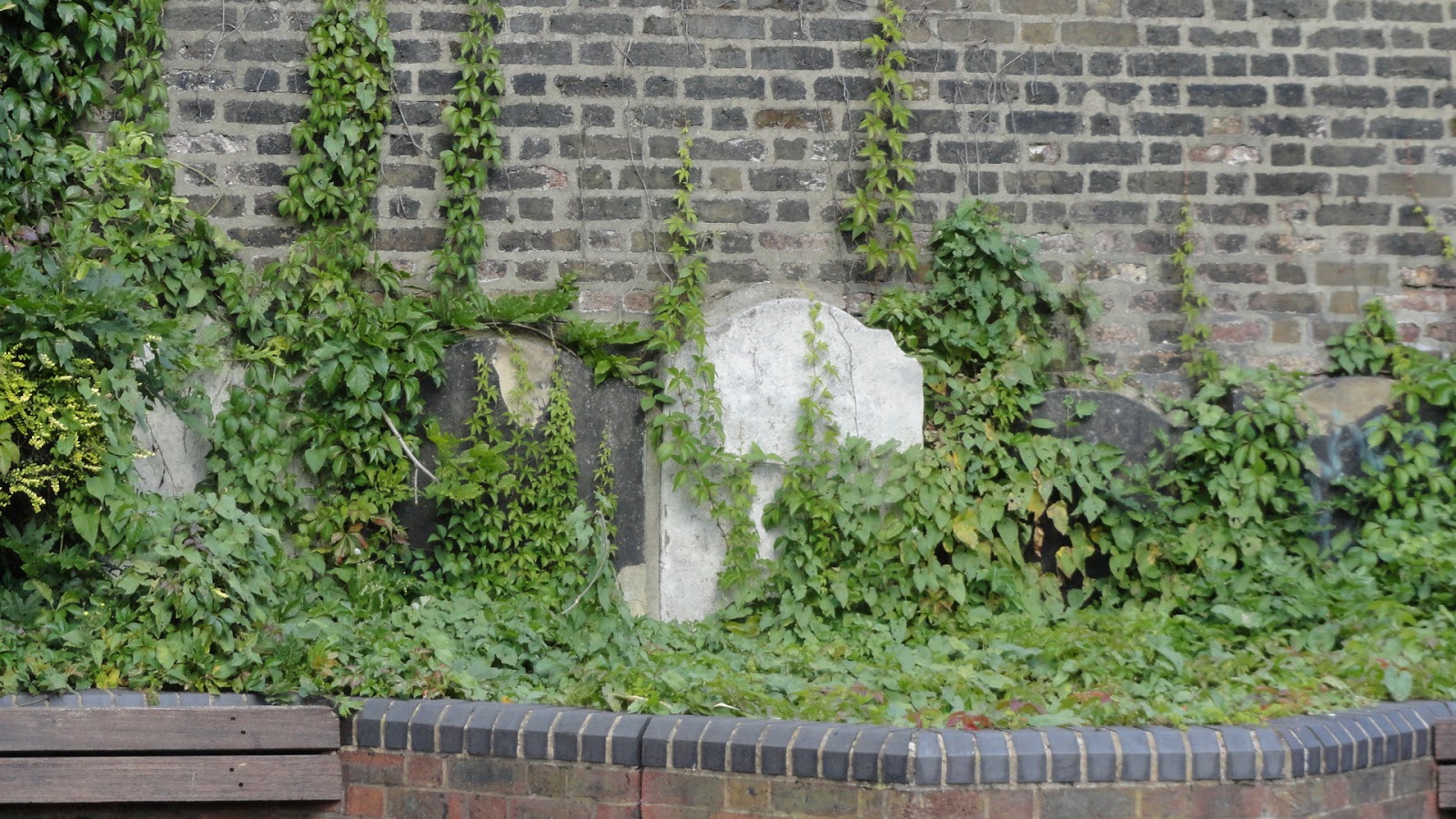 |
| Grave markers which were moved to the periphery of the recreation ground |
If you've read my blog for any length of time you'll be aware of my interest in historic cemeteries. The day I volunteered to do garden clean up at Highgate Cemetery, the tour I took of Kensal Green Cemetery, the stunning view of London from atop the hill at Greenwich Cemetery and the fact that I just enjoy poking around ancient headstones and wondering about the people beneath them is sufficient to justify my status as 'geek'. Not only that, but when you're looking for a truly peaceful and quite spot in a bustling city like London, a cemetery is where you'll find it.
Well, there I was, on a beautifully bright sunny day, sufficiently intrigued as to why this plot of ground in Vauxhall was so radically altered rather than letting everyone lie in peace, snapping a few photos so that I might go back later and study it some more when another member of the walking party admonished me to "have some respect".
Beg pardon?
I was so taken aback that I didn't say anything. Perhaps I should have inquired of him why he thought photographing the stones was disrespectful, when they obviously have not been cared for. Neglect, to me, is the ultimate expression of disrespect so he would have been better aiming his admonition at the borough council. My studies have lead to me to conclude that death was not viewed in the past as we view it now, life being much shorter and beset with disease, pestilence, and war. People were lucky to make it past their 40s, many did not expect to. I've also read of women taking rubbings of their beloved's grave marker as a keepsake; would that man tell them in their hour of grief that they were being disrespectful for doing so?
I didn't say anything but if I had it would be this: I am a garden historian. My job is to study the history of gardens and landscapes designed by humans. Pictures, be they sketches, engravings, maps, drawings, paintings, rubbings, etchings, or photographs are an integral part of that study. Burial grounds, be they large or small, are areas of land designed and created by man to serve a particular purpose, just like a public park or private garden. Some cemeteries have exquisite gardens and several around London can boast Grade I and II buildings and monuments constructed with incredible artistry and craftsmanship - skills in danger of becoming extinct - which makes them all fair game for the intrepid history sleuth out to, er, uncover the story behind a piece of landscape. If taking a photo of grave stones that were moved 100 years ago is disrespectful, what about the beautiful 19th century engravings of historic Highgate Cemetery?
 |
| Engraving of Highgate Cemetery c. 1858 (victorianweb.org) |
Images like this have been invaluable in the restoration and conservation of the Highgate grounds. Are the photos I took of the family marker for Celia Fiennes in the name of historical research disrespectful? Or the pics of my grandparents' and great-grandparents' markers for geneological research? (I can answer that one: no, they didn't mind. They were probably really happy to see me.)
 |
| Detail of the grave marker for Nathaniel Fiennes, his wife, two daughters who died in infancy, and daughter Celia (yes, I took the photo) |
 |
| Grave stones in the floor of Cafe in the Crypt, St. Martins in the Fields at Trafalgar Square (yes, I took this one, too) |
Where permitted I've happily snapped photos of the interiors of cathedrals and churches, tombs of long dead aristocracy, medieval effigies, grave stones on the floor and in the long grass, and intricately carved memorials. As for taking photos of them being disrespectful, what if, God forbid, the archives were lost? Restoration of any such space would be difficult, if not impossible, were it not for the aid of images. What if the church burned to the ground or some other natural disaster struck, like municipal development, that forever damaged or destroyed the markers intended to signify a person's final resting place? When I saw the marker for Celia Fiennes it was mounted on the wall but only because the church was rebuilt 100 years after she was buried so it effectually no longer marks her exact final resting place, which was beneath the stones of the church's floor. Besides, she was a progressive woman; I think she would have been intrigued by the curious device I was using.
Well, we know that bodies have been and continue to be moved, sometimes under horrific circumstances sometimes out of necessity, which is a helluva lot more invasive than snapping a photo of the marker from 10 feet away. So, to that person on the walk I say, I will - respectfully - continue to take photos of burial grounds when permitted and thank you very kindly for giving me such an appropriate blog topic for this spectral time of year. To celebrate, I give you a sampling of the frightening and fabulous architecture and artistry that are historic burial grounds, monuments and markers (all photos by me, except where noted, and all taken with the utmost respect).
 |
| Getting into Goth sprit at the Kensal Green Cemetery tour |
 |
| Hooray for grassland conservation at Greenwich Cemetery |
 |
| Greenwich Cemetery |
 |
| The most beautiful military graveyard I've ever seen at Greenwich Cemetery |
 |
| Early 19th century grave stone artistry at Cafe in the Crypt, London |
 |
| At Kensal Green Cemetery |
 |
| Kensal Green |
 |
| 18th century marker at Salisbury Cathedral |
 |
| Monument at Highgate Cemetery |
 |
| Medieval effigy at Salisbury Cathedral |
 |
| The Gothic architecture of Salisbury Cathedral |
 |
| Johannes Wordsworth at Salisbury Cathedral |
 |
| Monument detail at Salisbury Cathedral |
 |
| Hauntingly beautiful military marker at Salisbury Cathedral |
 |
| Highgate Cemetery, London |
 |
| Highgate Cemetery, London |
 |
| Markers in the garden at Postman's Park, London |
 |
| One of the touching plaques at the G.F. Watts's Memorial to Heroic Service at Postman's Park, London |
 |
| Beautiful and ghostly image from Melbourne Cemetery, Melbourne, Australia (I didn't take this one but I know who did and it was fellow history enthusiast Claudia Funder). |
 |
| Tomb marker for a member of the Austen family (relatives of Jane), St. Mildred's Church, Tenterden, Kent |
 |
| Jane's marker at Winchester Cathedral (austenonly.com) |
 |
| Detail of the memorial to Sam Wilson (d. 1918) by E. Caldwell Spruce, Lawnswood Cemetery, England (appythegardener.blogspot.com. See, I'm not the only one). |
Happy Halloween!
09 October 2012
The Triumph of Pleasure: Vauxhall Gardens
When I was a kid it was always a big deal when we went to an amusement park and in Southern California we had three to choose from. They offered everything a child and the child within could want for pleasure: exciting rides, various sugary comestibles that stuck to everything, shops, places to sit, plants and flowers, hormonal teens and young adults engaged in secret assignations, and lots of interesting people of all shapes, sizes, nationalities and classes mingling as equals. Little did my 10 year old self know that the amusement park had been around for centuries, though called by a different name, and that people did in them essentially the same things they do today.
London was no exception when the fashion of the pleasure garden made its way from the continent in the 17th century, with at least six of them dotted about the city. With the restoration of Charles II to the throne, fun and frivolity were back on the menu, a savory delight to be enjoyed by all (if you had the chinks to pay for it). The pleasure garden was a place for those of quality and gentility to seek amusement and diversion, a place to see and be seen, to be entertained, and to experience the newest thrilling industrial innovations. One such pleasure garden, and a leader of these novel venues, was at Vauxhall in Lambeth. Situated next to the Thames just south of the city, it was one of the prime social destinations of its day.
Rather coincidentally (or not), the pleasure gardens at Vauxhall opened the same year that poor Nicolas Fouquet threw a lavish party to show off his new house at Vaux le Vicomte to a jealous and enraged Louis XIV, who threw Nic in jail and commenced building the ultimate pleasure garden, Versailles. The takeaway lesson: One must never outshine the Sun King.
In England, things were a bit different and the monarchy were among those who frequented the city's pleasure gardens, though they had resplendent royal gardens of their own (think Hampton Court and Kensington Gardens).
Vauxhall takes its name from the landowners, the Fauxe, or Vaux, family derived from Falkes de Breauté, a mercenary working for King John, who acquired the land by marriage. Sometime after 1615, the land was sold and the development of the pleasure gardens began. The name changed over time - Falkes, Fox, Faux, Vaux - and the existence of a manor house, or hall, would logically give rise to the name Vauxhall. There are Vauxhall Gardens named after the English original in Canada and the US, and the Russian word for railway station is vokzal (Вокзал), attributed to a communication glitch between a delegation of Russians and their English hosts in the late 1800's. Oh, and the griffin emblem used by the car maker? It came from the de Breauté coat of arms.
Prior to that, the land surrounding Vauxhall had been marshland belonging to the manor of Lambeth in the 13th century. It wasn't until the marshlands were drained that the area became arable and began to be developed. Until the completion of Westminster Bridge in 1750 the only crossing on the Thames was at London Bridge, a fair distance away. No matter, the Thames was the M1 of its day and people made the boat journey to Vauxhall quite frequently. The celebrated gardener and diarist John Evelyn visited the gardens when they first opened in 1661, but the first mention of the pleasure gardens came from Samuel Pepys, who visited at least two dozen times, probably more.
In his diary, Pepys wrote of his first visit to the Pleasure Gardens: "Thence home, and with my wife and the two maids, and the boy, took boat and to Foxhall, where I had not been a great while. To the Old Spring Garden [at Charing Cross], and there walked long, and the wenches gathered pinks. Here we staid, and seeing that we could not have anything to eat, but very dear, and with long stay, we went forth again without any notice taken of us, and so we might have done if we had had anything. Thence to the New one [the New Spring Gardens at Vauxhall], where I never was before, which much exceeds the other; and here we also walked, and the boy crept through the hedge and gathered abundance of roses, and, after a long walk, passed out of doors as we did in the other place, and here we had cakes and powdered beef and ale, and so home again by water with much pleasure" (29 May 1662, a Thursday).
Addison describes his visit to the gardens in The Spectator, May 1712: "As I was sitting in my chamber, and thinking on a subject for my next Spector, I heard two or three irregular bounces on my landladys door; and at the opening of it, a loud cheerful voice inquiring whether the philosopher was at home. I immediately recollected that it was my good friend Sir Roger’s voice, and I had promised to go with him on the water to Spring Garden, in case it proved a good evening...we made the best of our way to Fauxhall. We were now arrived at Spring Garden, which is exquisitely pleasant at this time of year. When I considered the fragrancy of the walks and bowers, with the choir of birds that sung upon trees, and the loose tribe of people that walked under their shades. I could not but look upon the place as kind of Mahometan paradise. Sir Roger told me it put him in mind of a little coppice by his house in the country, which his chaplain used to call an aviary of nightingales...a mask who came behind him gave him a gentle tap on the shoulder, and asked him if he would drink a bottle of mead with her, but the knife, being startled at so unexpected a familiarity told her she was a wanton baggage, and bid her go about her business. We concluded our walk with a glass of Burton ale and a slice of hung beef. As we were going out of the garden, my old friend, thinking himself obliged, as a member of the quorum, to animadvert upon the morals of the place, told the, mistress of the house, who sat were more nightingales and fewer strumpets".
From 1728 under the astute management of Jonathan Tyers, son of a leather merchant, Spring Gardens as it was then called enjoyed tremendous popularity and patronage. Known for the quality of its art - which was aided by Tyers's new friend William Hogarth - and music, visitors who could afford the shilling entrance fee (about £7 in today's money; quite a bargain compared to Disneyland) mingled with royalty, aristocracy, and the new wealthy landowners and merchants. A season ticket made of silver and engraved with your name on it could be had for a guinea (about £150). You paid extra for refreshments but the music, art, dancing, and fireworks were free (hey, that's how amusement parks today are set up - wicked!). Men and women could also, er, mingle in the long leafy avenues or steal a quick snog among the bosquets. And just like the parks of today there were hair-raising rides in that gravity-defying new invention, the hot air balloon. Food, drink, music, fireworks, exciting rides and secret assignations - all rather familiar, wouldn't you say?
The gardens were at their heyday in the mid 1700s then slid into seediness over the next 100 years. Cut off from the river by the new rail lines and facing tougher competition from the Crystal Palace at the 1851 World's Exhibition in Hyde Park, the company visiting Vauxhall became unruly and the garden flowers were replaced with highly painted prostitutes until the gates were finally closed in 1859. The land was sold and developed, with all traces of the lovely walks and shady bowers erased. By the late 1800's no trace of the gardens remained.
The gardens might have been lost forever had not war intervened nearly a century later. During WW2 the area was bombed and received extensive damage. Of all the sites the bombs could have fallen, they fell on the site of the gardens. The target was likely the railway lines but apparently the enemy missed. In a commendable incidence of municipal foresight (or hindsight, as the case may be), instead of rebuilding the area it was landscaped and is once again a public garden.
The elaborate Rococo bandstand has been replaced with a basketball court, and the grand walks and flower gardens are hidden under earthworks which very well may cover heaps of Victorian rubble.

This street sign on the Albert Embankment still shows the way to Tethered Balloon Rides, a local attraction until 2002, until the London Eye won out for best and highest panoramic view of the city.

Even though the park is open to the public, it bears no resemblance to its former glorious setting and I found nothing about it even remotely amusing. There are no elaborate bandstands, no supper boxes, no art, no music (except on pedestrians' ear buds), no glittering lamps and no gardens. Just humps of lawn, some trees, the enclosed basketball court and a few benches. The few times I was there people were simply passing through, not lingering as they would have done when the gardens were at their peak which is a shame because the park could be so much more inviting.
A mural on the pedestrian tunnel leading from the railway station hints at the gardens' history, street names like Spring Gardens Walk, Lilac Place, and a pub called The Jolly Gardeners indicate some manner of floriferousness in the vicinity but there isn't a flower garden to be seen, not even a window box or hanging basket at the pub.
My question is: why not honor the gardens' past by planting some, well, gardens? When you look at other public spaces around London such as the Embankment Gardens, the rose garden in Hyde Park, the sunk garden at Kensington Gardens, and the flower beds at Regents Park, not to mention the countless public and private squares throughout the city, one wonders why the Borough of Lambeth has not considered a flower garden at Vauxhall Gardens a municipal necessity?
From what I understand, after the demise of the pleasure gardens the area went downhill pretty rapidly and is still economically depressed but in the late 19th and early 20th centuries there were girls' and boys' schools, an art school, and a vocational training program all within spitting distance of the gardens. Surely the creation of a garden would not only engage the community and provide educational initiatives for local school children, but would be an appropriate nod to the region's fabulous and long-reaching history, something which England has been known to be particularly proud of when it comes to conservation and restoration measures.
Perhaps in future the city council will look back in order to look forward and see fit to resurrect something of the Gardens' horticultural glamor. Perhaps then the Pleasure Gardens will triumph once again.
*Anyone born before 1982 might remember when Disneyland sold ticket books with alphabetically labelled tickets. An 'E' ticket was reserved for the most thrilling rides in the park, giving rise to the phrase, "An E-ticket ride", which I've often used to describe bus rides over narrow country lanes or certain friends' driving.
Edited to add: I neglected to mention a guided walk of the area lead by Ken Titmuss at http://londontrails.wordpress.com/, who kindly emailed an article detailing the history of the gardens. The walk does not focus on the history of the Pleasure Gardens so much as the development of the area after they closed. Still, the walk is enjoyable and ends at a charmingly restored tea room.
London was no exception when the fashion of the pleasure garden made its way from the continent in the 17th century, with at least six of them dotted about the city. With the restoration of Charles II to the throne, fun and frivolity were back on the menu, a savory delight to be enjoyed by all (if you had the chinks to pay for it). The pleasure garden was a place for those of quality and gentility to seek amusement and diversion, a place to see and be seen, to be entertained, and to experience the newest thrilling industrial innovations. One such pleasure garden, and a leader of these novel venues, was at Vauxhall in Lambeth. Situated next to the Thames just south of the city, it was one of the prime social destinations of its day.
 |
| Promo for the Pleasure Gardens, c. 1850 |
 |
| This map, dated 1753, clearly shows the location of Vauxhall Gardens (marked in pink), then known as Spring Gardens. For reasons unknown, the bottom of the page is north. |
Vauxhall takes its name from the landowners, the Fauxe, or Vaux, family derived from Falkes de Breauté, a mercenary working for King John, who acquired the land by marriage. Sometime after 1615, the land was sold and the development of the pleasure gardens began. The name changed over time - Falkes, Fox, Faux, Vaux - and the existence of a manor house, or hall, would logically give rise to the name Vauxhall. There are Vauxhall Gardens named after the English original in Canada and the US, and the Russian word for railway station is vokzal (Вокзал), attributed to a communication glitch between a delegation of Russians and their English hosts in the late 1800's. Oh, and the griffin emblem used by the car maker? It came from the de Breauté coat of arms.
Prior to that, the land surrounding Vauxhall had been marshland belonging to the manor of Lambeth in the 13th century. It wasn't until the marshlands were drained that the area became arable and began to be developed. Until the completion of Westminster Bridge in 1750 the only crossing on the Thames was at London Bridge, a fair distance away. No matter, the Thames was the M1 of its day and people made the boat journey to Vauxhall quite frequently. The celebrated gardener and diarist John Evelyn visited the gardens when they first opened in 1661, but the first mention of the pleasure gardens came from Samuel Pepys, who visited at least two dozen times, probably more.
In his diary, Pepys wrote of his first visit to the Pleasure Gardens: "Thence home, and with my wife and the two maids, and the boy, took boat and to Foxhall, where I had not been a great while. To the Old Spring Garden [at Charing Cross], and there walked long, and the wenches gathered pinks. Here we staid, and seeing that we could not have anything to eat, but very dear, and with long stay, we went forth again without any notice taken of us, and so we might have done if we had had anything. Thence to the New one [the New Spring Gardens at Vauxhall], where I never was before, which much exceeds the other; and here we also walked, and the boy crept through the hedge and gathered abundance of roses, and, after a long walk, passed out of doors as we did in the other place, and here we had cakes and powdered beef and ale, and so home again by water with much pleasure" (29 May 1662, a Thursday).
 |
| The Grand South Walk 1744 |
 |
| A general prospect of Vauxhall Gardens c. 1751 (The Foundling Museum) |
 |
| Balloon ascents were the E-ticket* ride of the 1850's |
 |
| Detail of Stanford's Geological Survey map of 1878 showing the new developments over the former garden site |
 |
| Current Ordnance Survey map of Vauxhall |

This street sign on the Albert Embankment still shows the way to Tethered Balloon Rides, a local attraction until 2002, until the London Eye won out for best and highest panoramic view of the city.

Even though the park is open to the public, it bears no resemblance to its former glorious setting and I found nothing about it even remotely amusing. There are no elaborate bandstands, no supper boxes, no art, no music (except on pedestrians' ear buds), no glittering lamps and no gardens. Just humps of lawn, some trees, the enclosed basketball court and a few benches. The few times I was there people were simply passing through, not lingering as they would have done when the gardens were at their peak which is a shame because the park could be so much more inviting.
A mural on the pedestrian tunnel leading from the railway station hints at the gardens' history, street names like Spring Gardens Walk, Lilac Place, and a pub called The Jolly Gardeners indicate some manner of floriferousness in the vicinity but there isn't a flower garden to be seen, not even a window box or hanging basket at the pub.
 |
| Mural on the wall of the pedestrian tunnel under the railway tracks shows the splendor of the gardens |
My question is: why not honor the gardens' past by planting some, well, gardens? When you look at other public spaces around London such as the Embankment Gardens, the rose garden in Hyde Park, the sunk garden at Kensington Gardens, and the flower beds at Regents Park, not to mention the countless public and private squares throughout the city, one wonders why the Borough of Lambeth has not considered a flower garden at Vauxhall Gardens a municipal necessity?
From what I understand, after the demise of the pleasure gardens the area went downhill pretty rapidly and is still economically depressed but in the late 19th and early 20th centuries there were girls' and boys' schools, an art school, and a vocational training program all within spitting distance of the gardens. Surely the creation of a garden would not only engage the community and provide educational initiatives for local school children, but would be an appropriate nod to the region's fabulous and long-reaching history, something which England has been known to be particularly proud of when it comes to conservation and restoration measures.
 |
| What Vauxhall Pleasure Gardens needs is more gardens |
*Anyone born before 1982 might remember when Disneyland sold ticket books with alphabetically labelled tickets. An 'E' ticket was reserved for the most thrilling rides in the park, giving rise to the phrase, "An E-ticket ride", which I've often used to describe bus rides over narrow country lanes or certain friends' driving.
Edited to add: I neglected to mention a guided walk of the area lead by Ken Titmuss at http://londontrails.wordpress.com/, who kindly emailed an article detailing the history of the gardens. The walk does not focus on the history of the Pleasure Gardens so much as the development of the area after they closed. Still, the walk is enjoyable and ends at a charmingly restored tea room.
07 September 2012
Great Barn Restoration at Great Dixter
As any garden designer knows, the composition of a garden is more than just plants. There are other elements to consider: water, the form of the land, climate, paving, and buildings. In the not-too-distant past gardens were designed around structures from which the garden could be viewed and appreciated, the buildings and the gardens integrated into a unified whole. Without one, the other would be incomplete. Great Dixter is that kind of garden with that kind of house but it's the Great Barn that was in the spotlight last weekend.
The Great Barn, with medieval timbers and triple-cowled 19th century oast house, is a massive hulk of a structure brooding over several parts of the garden. It gives the Barn Garden its name and when viewed from down in the Sunk Garden, the enormous undulating sea of roof tiles is almost imposing yet you never feel engulfed by it.
The white cowls of the Oast House pivot with the wind and are a reminder of this garden's past as a working farm. The medieval farmer who sheltered his beasts in the barn over winter and the 19th and 20th century hop workers processing the season's harvest probably wouldn't recognize the garden today, but they would know that structure without a shadow of a doubt.
It's fortunate for us and for the history of the area that these buildings were preserved when the Lloyd family bought the tired estate in 1909. Edwin Lutyens designed the gardens around them - the barn, cattle troughs, hovels, bothies, cart sheds, even a pig pen, were all woven into the fabric of the garden and are integral notes in the composition. Perhaps even more fortunate was the desire by the current Trust to restore these wonderful edifices to their former glory instead of following the trend of commercial conversion to tea rooms and gift shops.
Don't get me wrong, I've been to plenty of gardens with fancy stable blocks converted to tea rooms and gift shops and, for the most part, all have been well done and they work for those gardens but covering the interior of Dixter's wonderful old barn with sheet rock and plunking in a lino service counter burdened with cakes and packaged sandwiches just isn't Dixter. Christopher Lloyd was adamant that the place not be mothballed and sealed in aspic when he died, nor that it become too commercialized or institutionalized. Head gardener and Trust CEO Fergus Garrett is determined that Christo's wishes be honored and the character of Great Dixter be respected in every aspect of managing the gardens, right down to the care of these magnificent old buildings. The world needs more like Fergus, I say.
Fergus called the restoration of the barn "the icing on the cake" of a multi-million pound restoration scheme focused on the buildings that has been ongoing since Christo's death in 2006, including the acquisition of Dixter Farm down the track, which was restored and made into an education center and student accommodations. Now there's a worthy conversion for you. With a grant from the Heritage Lottery Fund and donations from friends and private contributors, the barn project began in late 2011. I was fortunate enough to be there to see it before work began, then to visit as it was ongoing, and finally to see the fabulous new restoration opened to the public.
One of the things I love about Dixter is their stewardship of the land. With an eye to the future oak from the Dixter woods was harvested years ago, milled, and set out to season so it could be used in the restoration. Some was used in the house to replace rotting 15th century timbers, and as much as possible was used in the barn. The coppice woods are still managed and the poles, peasticks, twigs, etc. are all still used in the gardens. Students this year even learned how to split sweet chestnut and make ladders and hurdles, all with hand tools. In keeping with this form of management that honors the ancient traditions, an area of the barn was set up to demonstrate these hand-crafts and the products made there are put to work in the garden or made available in the shop. All using locally sourced materials, all made by traditional hand-craft, right there under the beams of the medieval barn. How cool is that!?
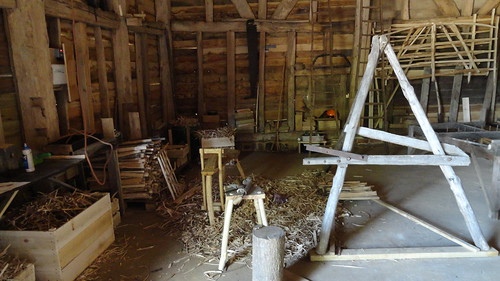 But enough talk, there are lots of pictures to see. If you're in East Sussex this autumn, a stop at Dixter is a must. The house and garden - and now great barn - are open until 28 October and believe me when I tell you there will still be plenty to see in the garden.

The garden at Great Dixter is open Tuesday - Sunday and Bank Holiday Mondays from 11-5 and the house is open from 2-5 until 28 October and will re-open 1st April. See their website for admission cost and special events and study days throughout the year.
Links to videos of the project can be found here and here. Watch them. But be warned, you just might fall in love with the place.
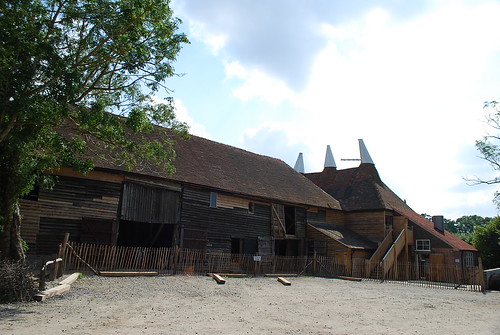 |
| The Great Barn, Great Dixter |
The white cowls of the Oast House pivot with the wind and are a reminder of this garden's past as a working farm. The medieval farmer who sheltered his beasts in the barn over winter and the 19th and 20th century hop workers processing the season's harvest probably wouldn't recognize the garden today, but they would know that structure without a shadow of a doubt.
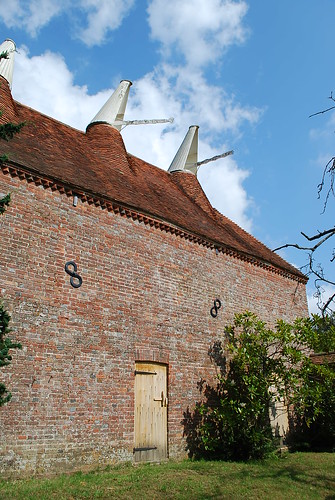 |
| South face of the Oast House |
Don't get me wrong, I've been to plenty of gardens with fancy stable blocks converted to tea rooms and gift shops and, for the most part, all have been well done and they work for those gardens but covering the interior of Dixter's wonderful old barn with sheet rock and plunking in a lino service counter burdened with cakes and packaged sandwiches just isn't Dixter. Christopher Lloyd was adamant that the place not be mothballed and sealed in aspic when he died, nor that it become too commercialized or institutionalized. Head gardener and Trust CEO Fergus Garrett is determined that Christo's wishes be honored and the character of Great Dixter be respected in every aspect of managing the gardens, right down to the care of these magnificent old buildings. The world needs more like Fergus, I say.
Fergus called the restoration of the barn "the icing on the cake" of a multi-million pound restoration scheme focused on the buildings that has been ongoing since Christo's death in 2006, including the acquisition of Dixter Farm down the track, which was restored and made into an education center and student accommodations. Now there's a worthy conversion for you. With a grant from the Heritage Lottery Fund and donations from friends and private contributors, the barn project began in late 2011. I was fortunate enough to be there to see it before work began, then to visit as it was ongoing, and finally to see the fabulous new restoration opened to the public.
 |
| Opening of the Great Barn 3 Sept 2012 |
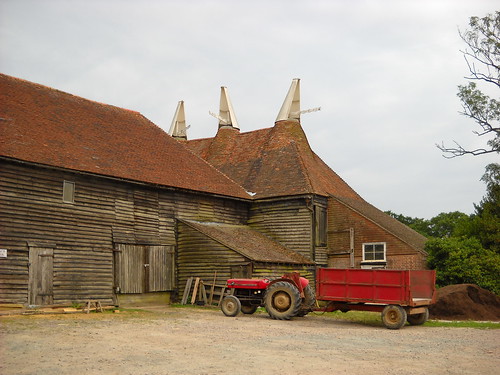 |
| The Great Barn and Oast House in Spring 2011 before restoration began |
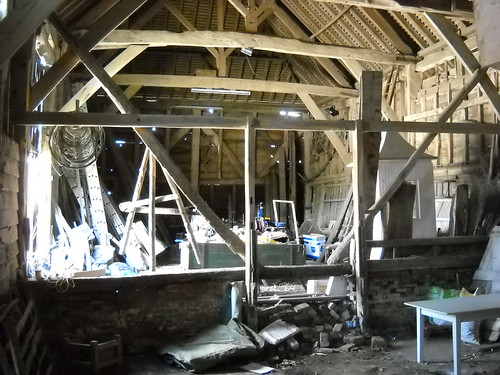 |
| Spring 2011 |
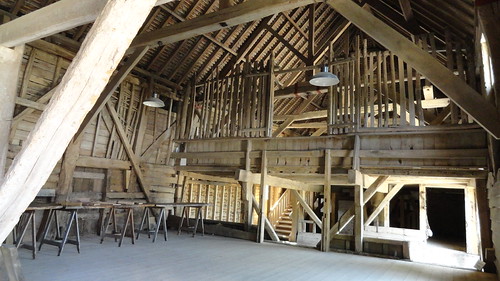 |
| Sept. 2012 |
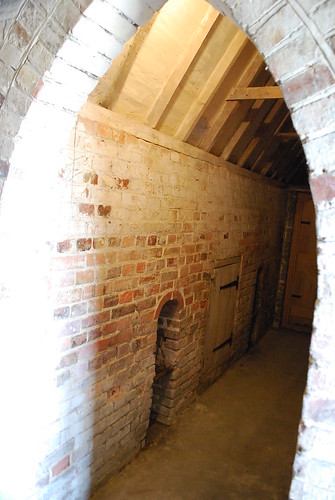 |
| Brimstone would have been kept in the curved niches to feed the fire (middle door) under the drying floor |
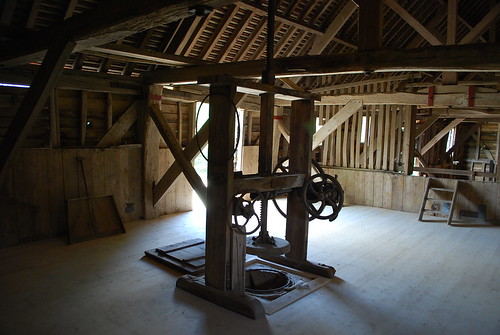 The restored hop press. Dried hops were pressed into bags hanging from below. 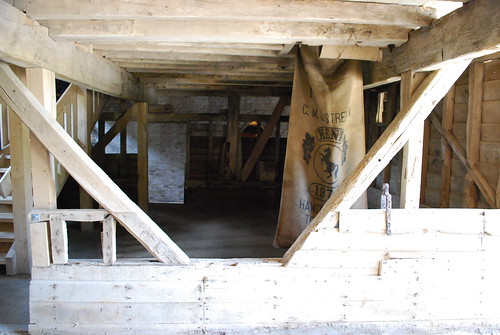 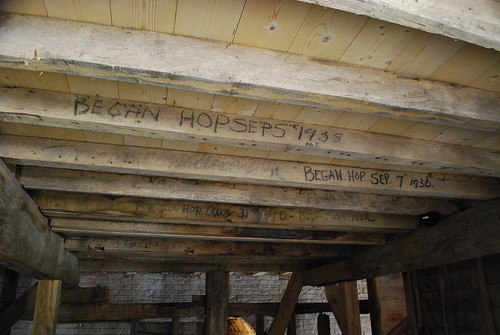 Hop workers wrote the start date of hops harvest on the joists, which have been preserved. 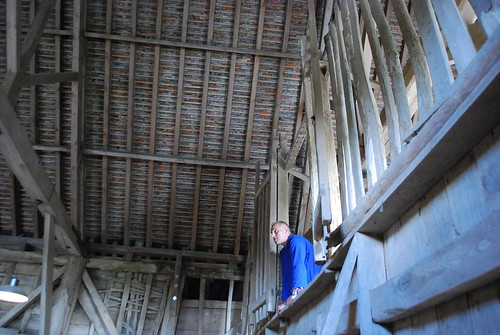 |
| Fergus addresses the crowd on opening day 3 Sept 2012 |
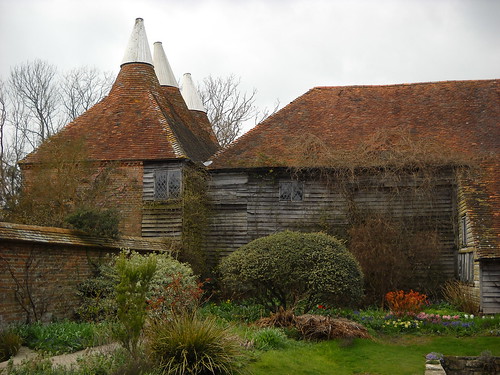 |
| Exterior of the barn and oast before restoration, Spring 2011 |
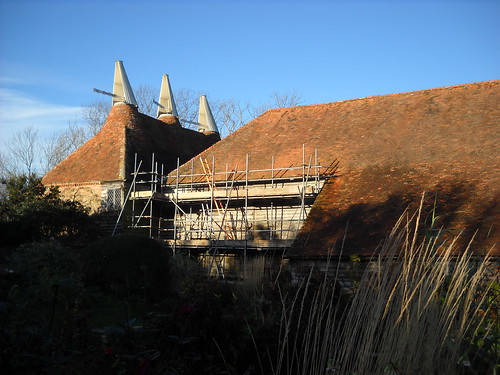 |
| November 2011 |
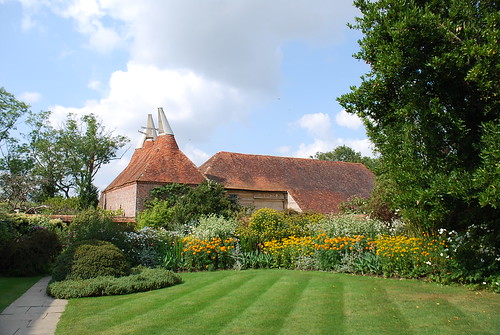 |
| September 2012, seen from the Solar Garden |
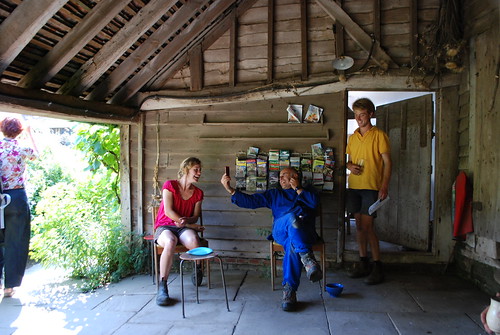 |
| The garden side of the barn offers shelter for visitors and a mess room for the gardeners. Fergus shares a moment with Rachael and James, the first two Christopher Lloyd Scholars (notice they're all wearing primary colors. I love that!) |
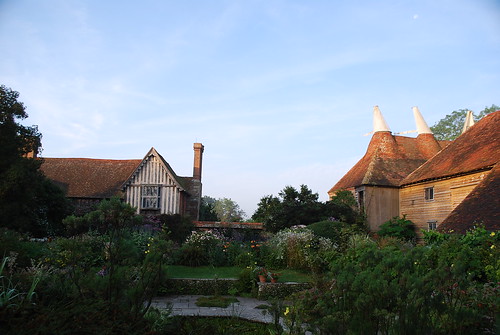 |
| Testimonies to enduring craftsmanship and sensitive stewardship: early morning light touches the 15th century Great Hall, 19th century oast and medieval great barn with a pale setting moon (top right) smiling down. Try imagining the garden without them. 4 Sept. 2012 |
Links to videos of the project can be found here and here. Watch them. But be warned, you just might fall in love with the place.
Subscribe to:
Posts (Atom)